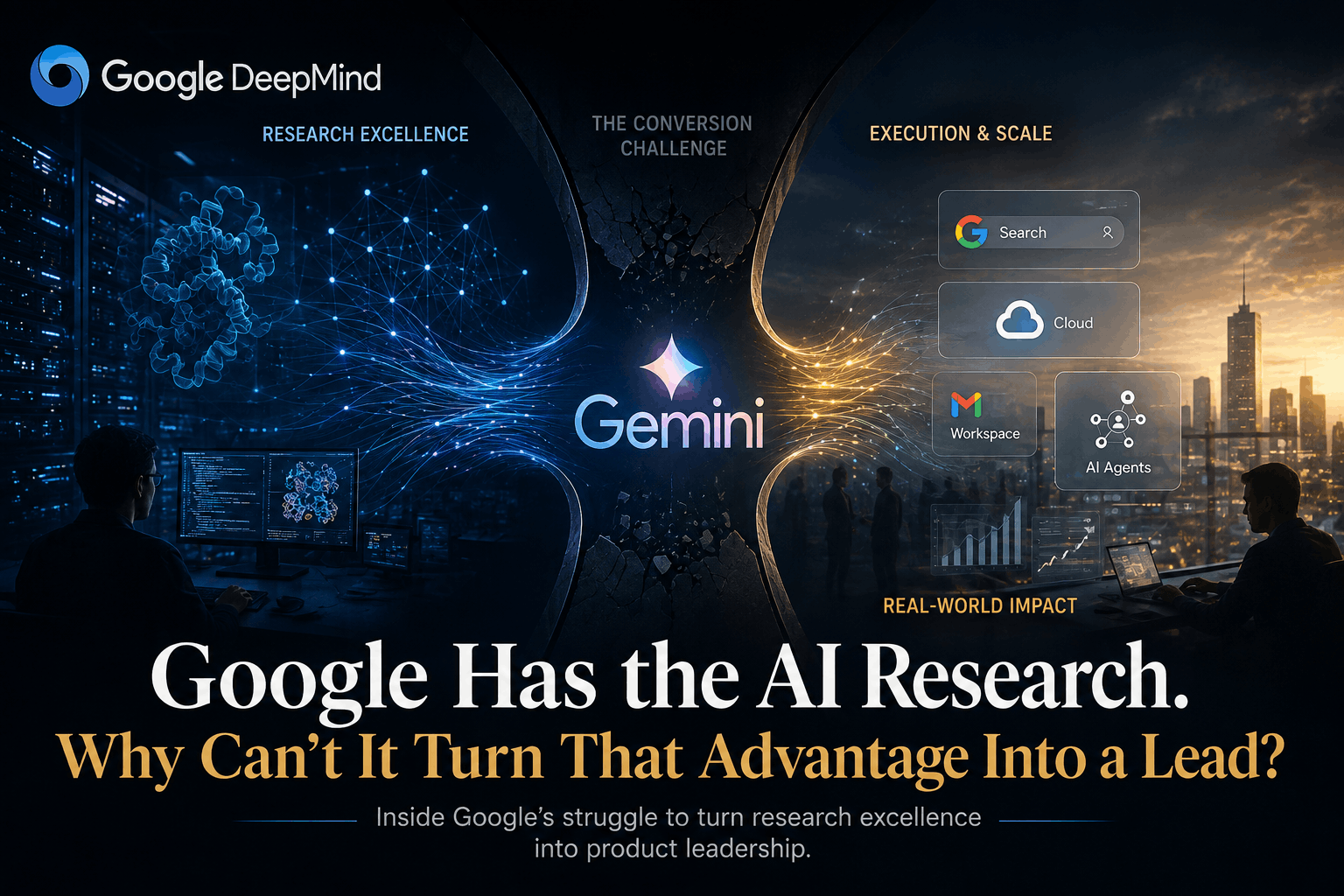
Google Has the AI Research. Why Can’t It Turn That Advantage Into a Lead?
The reshuffle is a symptom, not the story
Google is changing the way it runs one of the world’s most important artificial-intelligence organizations. Demis Hassabis, the scientist who has led Google DeepMind through its transformation into Google’s central AI research organization, is moving away from day-to-day management and toward a broader role focused on long-term AI research, science and strategy. Koray Kavukcuoglu, previously DeepMind’s chief technology officer and Google’s chief AI architect, is taking greater operational control, including responsibility for pushing Gemini forward.
The change comes at an awkward moment for Google. The company is simultaneously losing some of its most experienced AI leaders. Jeff Dean, one of Google’s most influential engineers and a key figure in the company’s AI history, is leaving after roughly 27 years to establish Discovery Loop alongside fellow researchers Oriol Vinyals, Quoc Le and Sanjay Ghemawat. Other prominent researchers have also moved to competitors including OpenAI and Anthropic.
At the same time, Google is trying to concentrate its enormous AI operation around Gemini. The company has the researchers, custom AI chips, cloud infrastructure, capital and global distribution that should make it one of the industry’s strongest contenders. Yet Gemini has faced renewed competitive pressure, while Google’s internal organization has struggled with computing constraints, competing priorities and the sheer complexity of coordinating AI development across a company of Google’s scale.
That is what makes the reshuffle more important than a change in executive titles.
Google is not reorganizing its AI operation because it lacks AI talent. It is reorganizing because its extraordinary research and infrastructure advantages have not consistently translated into the kind of product speed and market leadership demonstrated by AI-native competitors.
The company that helped lay much of the technological foundation for today’s AI boom now has to solve a very different problem: how to turn research breakthroughs into products, products into adoption, and adoption into economic value—quickly enough to keep pace with OpenAI and Anthropic.
How did the company that helped create so much of modern AI end up fighting to keep pace with the companies that followed it into the race?
Google Should Have Been the Company That Won AI
If the generative-AI race had been decided by research credentials alone, Google would have entered it as the overwhelming favorite.
Long before ChatGPT turned artificial intelligence into a mainstream product, Google had already built one of the world’s deepest AI research organizations. Google Brain became a major center for machine-learning research, while DeepMind developed systems that demonstrated how far artificial intelligence could go in areas ranging from games to scientific discovery. The two organizations eventually merged into Google DeepMind, bringing together some of the industry’s most influential researchers and engineers.
More importantly, Google’s influence extends into the underlying technology on which today’s AI industry has been built. Research originating at Google helped advance the Transformer architecture that became foundational to modern large language models. DeepMind’s AlphaGo demonstrated the potential of sophisticated learning systems years before the current generative-AI boom, while AlphaFold showed that AI could move beyond language and into fundamental scientific problems.
Google also possessed something many of its competitors could not easily replicate: the infrastructure required to turn research into large-scale AI systems. Its custom Tensor Processing Units, enormous data-center footprint and Google Cloud infrastructure gave the company access to vast amounts of computing power. Its global distribution was even more formidable. Search, Android, YouTube, Workspace and other Google products put billions of users within reach of any AI technology the company could successfully deploy.
And then there was the talent.
Google had assembled researchers who had helped shape modern machine learning, while continuing to attract some of the industry’s most accomplished scientists. The creation of Google DeepMind in 2023 was itself an attempt to consolidate this advantage after ChatGPT exposed the urgency of the new AI competition.
On paper, the pieces were almost absurdly favorable.
Research. Talent. Compute. Chips. Cloud infrastructure. Capital. Data. Distribution.
Google had all of them.
Yet the company did not become the defining consumer AI company of the first wave of generative AI. OpenAI did.
That is the paradox at the center of Google’s current AI strategy.
Google did not enter the generative-AI race from behind. It helped build much of the technological foundation on which that race was being run. But when the technology moved from research laboratories into mass-market products, Google’s advantages did not automatically translate into the same kind of momentum.
The difference matters.
The AI race was no longer simply about who could produce important research breakthroughs. It increasingly became a race to turn those breakthroughs into products, distribute them at scale, learn from millions of users and improve them faster than competitors.
And that raises the question that sits behind Google’s latest leadership reshuffle:
If Google had the researchers, infrastructure, capital and distribution to become the defining AI company, why did OpenAI become the company that defined the generative-AI era?
The ChatGPT Moment Changed the Competitive Equation
For years, Google’s advantage in AI followed a familiar formula: research → infrastructure → products. Breakthroughs could take years to mature, but Google had the resources to move them through its research laboratories, computing infrastructure and eventually into products used by billions of people.
ChatGPT changed the market’s expectations almost overnight.
When OpenAI released ChatGPT in late 2022, the significance was not simply that another AI model had arrived. It was that frontier AI had suddenly become a consumer product. Millions of people could interact directly with a powerful language model through a simple interface, while developers began experimenting with its capabilities through APIs. AI research was no longer confined to laboratories or buried inside existing products. It had become the product itself.
That changed the competitive equation.
The emerging model became:
Research → model → product → users → feedback → rapid iteration
Speed suddenly mattered almost as much as research quality. The company that could put a capable model in front of users, learn from how they used it and improve the system quickly could build an advantage that traditional research cycles could not easily match.
OpenAI benefited from this new dynamic. ChatGPT gave the company an enormous consumer distribution channel, while successive model releases kept developers and businesses engaged with the platform. The interface itself also became important: instead of asking users to understand machine learning, ChatGPT gave them a simple way to experience what increasingly capable AI could do.
Google, meanwhile, had to respond to a disruption it had helped make possible but had not been the first to commercialize at mass scale.
Its response was substantial. Google merged Google Brain and DeepMind in 2023 to create Google DeepMind, concentrating some of its strongest AI capabilities into a single organization. Gemini became the centerpiece of Google’s attempt to compete at the frontier.
But the strategic position had changed.
Google was no longer simply developing AI and deciding when to integrate it into its products. It was now competing in a market where the product itself was becoming the primary mechanism through which AI capabilities improved and spread.
That put Google in an uncomfortable position. It had enormous resources, but it was increasingly responding to a market that OpenAI had helped define.
Gemini eventually demonstrated that Google could compete at the frontier. But the company’s subsequent struggles with model development, release timing and competition from newer systems reinforced a difficult perception: Google could catch up, but it was having a harder time setting the pace.
And that distinction is critical.
The first phase of the AI race rewarded companies that could build powerful models. The emerging phase rewarded companies that could turn those models into products, get them into users’ hands and improve them faster than everyone else.
Google had spent decades perfecting the first part of that equation.
ChatGPT forced it to master the second.
Google’s Real Problem Isn’t Research. It’s Execution.
Google’s AI problem is easy to misdiagnose.
It is not a shortage of researchers. It is not a shortage of computing infrastructure. And it is certainly not a shortage of money. The company has some of the industry’s deepest AI expertise, its own custom AI chips and an enormous global infrastructure on which to train and deploy models.
The problem is what happens when all of those resources have to be coordinated quickly.
People familiar with Gemini’s development have described an organization in which computing capacity, competing priorities and multiple project leaders can complicate the process of deciding where resources should go. Google’s TPUs are a critical bottleneck: different AI projects compete for access to the computing capacity required to train and develop increasingly large models.
That creates a problem that is easy to underestimate.
Having more resources does not necessarily mean being able to deploy them faster.
A company can possess enormous computing capacity and still struggle to allocate it efficiently. It can employ thousands of AI researchers and still have difficulty deciding which projects deserve priority. And it can have several technically capable teams working on the same objective while losing time to disagreements over priorities and resource allocation.
That appears to be part of the challenge Google is facing with Gemini.
According to the report, people familiar with its development described competing groups and constraints around resources, with areas such as coding not always receiving the level of investment required. The company’s next flagship Gemini model has also faced delays, while internal testing reportedly identified weaknesses in areas including coding.
None of this suggests that Google’s researchers suddenly became less capable.
It suggests something more consequential: the organization around those researchers may not be moving at the same speed as the technology itself.
This distinction matters because AI has changed the economics of software development. In a conventional technology business, a large organization can sometimes afford lengthy product cycles. Research can be developed, tested and integrated over extended periods before reaching users.
Frontier AI is less forgiving.
Models improve rapidly. Competitors can release a stronger system and change user expectations almost immediately. Developers can switch tools. Consumers can move between AI assistants. A capability that appears impressive today can become table stakes within months.
That makes deployment speed a competitive capability in its own right.
OpenAI and Anthropic are therefore not competing with Google only on the intelligence of their models. They are competing on how quickly they can turn improvements in those models into products that users can actually experience.
Google has a different challenge.
Its AI systems must operate inside one of the world’s largest technology companies, where resources are shared across products, research programs and business units. The same breadth that gives Google extraordinary advantages can also create more decisions, more dependencies and more competing priorities.
This is the execution gap.
Research creates potential. Execution converts potential into competitive advantage.
Google has spent decades becoming exceptionally good at the first. The question now is whether it can become fast enough at the second.
That may explain why the latest restructuring places greater operational authority around Gemini and gives Koray Kavukcuoglu a more central role in coordinating Google’s AI efforts. The objective is not simply to produce another technically impressive model. It is to make Google’s enormous collection of AI capabilities behave more like a single, focused machine.
And that is the deeper challenge facing Google.
The company built an AI research engine powerful enough to produce breakthroughs that changed the industry. But the AI race has entered a phase in which the advantage may belong less to the company with the most research and more to the company that can turn research into products fastest.
Google therefore does not simply need a better model.
It needs a faster way of turning what it already knows into something the market can use.
Google’s Greatest Strength May Also Be Its Biggest Constraint
Google’s scale is one of its greatest advantages in artificial intelligence—and potentially one of its greatest constraints.
Few companies can match the breadth of Google’s AI ecosystem. The company operates frontier AI research through Google DeepMind, develops its own AI chips, sells computing through Google Cloud, and can distribute AI capabilities through Search, Android, YouTube, Workspace and a vast collection of consumer and enterprise products. It also has the financial resources to invest heavily in data centers and computing infrastructure while pursuing AI applications in areas ranging from scientific research to drug discovery.
On paper, this should create an almost unbeatable competitive position.
But breadth comes with a cost: coordination.
Every additional business, product and research program creates another set of priorities competing for the same scarce resources. Computing capacity has to be allocated. Researchers have to be assigned to projects. Product teams have to decide which AI capabilities to integrate. Cloud has its own commercial priorities, while Search has a different set of incentives. Scientific research may require years before producing a commercial result, while Gemini may need improvements within months—or weeks.
Google therefore faces a problem that is less visible from the outside.
It does not simply have to decide what it can build.
It has to decide what it should build first.
That is a fundamentally different challenge from the one facing AI-native competitors.
OpenAI and Anthropic are not free of organizational complexity, and neither company is operating on a small scale anymore. But their businesses are more tightly concentrated around frontier AI and the products built around it. Their strategic question is relatively direct: improve the models, build useful systems around them and expand adoption.
Google has to make those decisions while protecting businesses that generate enormous amounts of existing revenue.
That creates an unusual tension.
The company cannot treat AI as an isolated startup because AI increasingly affects almost every part of Google. But it also cannot allow every Google business to pursue its own AI priorities independently without risking fragmented resources and slower execution.
This helps explain why Google’s current restructuring matters.
The objective appears to be not simply adding more AI capability, but concentrating the capability Google already possesses around clearer priorities—above all, Gemini. The shift toward greater centralized authority and closer integration between DeepMind, Google’s products and Cloud reflects an attempt to reduce the distance between research and deployment.
This is why describing Google’s challenge simply as “bureaucracy” misses the deeper point.
The problem is not that Google has too many advantages. It is that those advantages have to be coordinated.
Scale gives Google more researchers, more computing power, more products and more distribution than most competitors. But scale also means more dependencies, more competing priorities and more decisions.
In a slower-moving technology market, that complexity can be manageable.
In frontier AI, where a competitor can change the market with a new model or product release, coordination itself becomes a competitive variable.
Google’s challenge, then, is not to become smaller.
It is to make a company of extraordinary scale move with the focus of a much smaller one—without giving up the advantages that made its scale so valuable in the first place.
Why Demis Hassabis Is Moving Up—and Koray Kavukcuoglu Is Moving In
Seen in isolation, Google’s latest leadership change could look like a reshuffling of titles. Demis Hassabis is moving away from the day-to-day management of Google DeepMind and into a broader role as chairman and Alphabet’s chief scientist, while Koray Kavukcuoglu is taking greater operational responsibility for the organization and its Gemini efforts. But viewed against Google’s broader AI challenge, the division of responsibilities looks more deliberate.
Hassabis is not leaving Google’s AI effort. His role is moving in the opposite direction: toward the questions that sit further out on the technological horizon.
His focus will include artificial general intelligence, fundamental AI research, scientific applications and the longer-term implications of increasingly capable AI. He will also remain involved with Isomorphic Labs, Google’s AI-driven drug-discovery venture.
That is a role suited to someone whose greatest value may lie not in managing hundreds of operational decisions, but in determining where AI research is heading next.
Kavukcuoglu represents a different requirement.
As DeepMind’s former chief technology officer and Google’s chief AI architect, he has already been involved in connecting Gemini with Google’s broader products and businesses. His expanded authority places him closer to the immediate problems Google needs to solve: model development, product integration, computing resources, coordination across teams and the commercial deployment of AI.
That distinction matters because Google’s challenge is no longer simply to produce important AI research.
It needs to deploy that research at extraordinary scale.
Gemini has to work across Google’s ecosystem. Its models need computing capacity. Its capabilities need to reach Search, Cloud and other products. Researchers and engineers need to agree on priorities. Resources need to move toward the areas where competitors are gaining ground. And the company needs to shorten the distance between a research breakthrough and something users can actually experience.
That is fundamentally an operational problem.
The new structure therefore appears to separate two jobs that Google previously concentrated more heavily around the same leadership: advancing the frontier of AI and turning that frontier into products.
Hassabis can focus further upstream—on AGI, science and the long-term direction of the technology.
Kavukcuoglu can focus further downstream—on Gemini, infrastructure, coordination and execution.
This is not necessarily a retreat from research. It may instead be an attempt to make research and execution complementary rather than competing priorities.
The distinction is important because Google’s historical strength came from giving researchers room to pursue difficult problems whose commercial value might not be immediately obvious. Its current challenge is that the AI market is moving too quickly to leave the translation from research to product entirely decentralized.
The leadership change is therefore best understood not as Hassabis stepping down, but as Google redefining what it needs from its AI leadership.
Hassabis represents the question of what AI can become. Kavukcuoglu is being asked to solve the question of what Google can do with it now.
Whether Google can make those two missions reinforce each other—rather than compete for attention and resources—may determine whether its enormous research advantage finally becomes a durable product advantage.
From DeepMind Laboratory to Google’s AI Engine
DeepMind was not originally built to be a conventional product organization.
Its reputation came from pursuing difficult problems whose commercial applications were often distant or uncertain. The laboratory’s culture was built around fundamental research, ambitious scientific questions and the long-term pursuit of increasingly capable artificial intelligence. AlphaGo and AlphaFold became powerful demonstrations of what that model could produce: research breakthroughs first, commercial applications later.
Google’s relationship with DeepMind has steadily changed.
The creation of Google DeepMind in 2023 brought DeepMind and Google Brain together, creating a much larger AI organization designed to concentrate Google’s research capabilities. The latest restructuring pushes that integration further. Some teams are moving into Google’s corporate organization, decision-making is becoming more centralized and Gemini is increasingly positioned as the primary vehicle through which Google’s AI capabilities reach its products and businesses.
The emerging model looks very different:
Research → Gemini → Google products → Cloud → enterprise AI → revenue
There is a clear strategic logic to this transformation.
A more integrated organization can potentially allocate computing resources more efficiently, reduce duplication, coordinate researchers and product teams, move models into Google’s products faster and concentrate investment behind the areas most likely to matter commercially. Google’s AI research is no longer being developed in isolation from the businesses that ultimately need to use it.
For a company spending enormous amounts on AI infrastructure, that connection is becoming increasingly important.
But integration creates a trade-off.
The same independence that allowed researchers to pursue ambitious problems without an immediate commercial objective can become harder to preserve when research organizations are measured increasingly against product roadmaps. Scientists may have less freedom to pursue projects that fall outside Gemini’s priorities. Long-term experiments can compete with short-term demands. Research that could produce a breakthrough several years from now may struggle for resources against capabilities that need to ship this quarter.
That does not mean commercialization will weaken DeepMind.
It could do the opposite.
Putting researchers closer to enormous computing resources, product teams and billions of potential users could accelerate the journey from scientific breakthrough to real-world impact. Google’s distribution could give DeepMind’s research an audience and commercial pathway that an independent laboratory could never match.
The question is whether Google can capture those advantages without eliminating the conditions that produced the research in the first place.
That is the central tension in the restructuring.
DeepMind’s historic strength was its ability to think beyond the immediate product cycle. Google’s current AI challenge requires it to move faster within that cycle.
The company therefore has to perform a difficult balancing act: make DeepMind more commercially effective without making it less scientifically exceptional.
If Google succeeds, tighter integration could turn DeepMind’s research engine into one of the most powerful AI product engines in the world.
If it fails, Google could discover that the pursuit of faster commercialization has weakened one of the very research cultures that gave it an advantage in the first place.
Why Is Google Losing Some of Its Best AI Researchers?
Google’s AI talent problem is more difficult to explain than a simple list of departures.
The company continues to employ one of the world’s largest concentrations of AI researchers. Yet some of the people who helped build that advantage are now leaving. Jeff Dean, one of Google’s most influential engineers and a key figure in Google Brain and Google DeepMind, is departing after roughly 27 years to build a new company, Discovery Loop. He is being joined by fellow Google researchers Oriol Vinyals, Quoc Le and Sanjay Ghemawat. Other prominent researchers, including Noam Shazeer and John Jumper, have also moved to OpenAI and Anthropic.
The important question is not simply who is leaving.
It is why they would leave at all.
Google can offer researchers resources that few organizations in the world can match: enormous computing infrastructure, access to some of the industry’s strongest technical teams, massive datasets and the financial capacity to pursue ambitious AI projects. Leaving such an organization would therefore seem counterintuitive—unless the opportunity outside Google offers something those resources cannot provide.
One possibility is autonomy.
Inside a company as large as Google, researchers inevitably operate within a network of product priorities, organizational decisions and resource constraints. An independent company can be built around a much narrower objective. For a scientist with a specific vision for how AI could transform scientific research, engineering or another field, that freedom may itself be valuable.
Discovery Loop is an interesting example.
Dean and his colleagues are not leaving AI behind. They are taking their expertise into a new organization focused on using AI to accelerate scientific and engineering experimentation, with ambitions spanning areas such as drug discovery, clean energy and other scientific problems.
That suggests the departure should not automatically be interpreted as a rejection of Google’s technology or research capabilities.
It may instead reflect a changing opportunity structure around AI.
The most talented researchers can now choose among several paths: remain inside a large technology company with extraordinary resources, join an AI-native company focused on frontier models, or create an entirely new organization around a specific scientific or technological vision.
The incentives can be different in each environment.
A startup can offer greater control over research direction, a concentrated mission, potentially significant equity and the ability to make decisions without navigating the priorities of a much larger organization. It can also allow researchers to build around an emerging opportunity before it becomes a major corporate priority.
But there is an important caveat.
The available evidence does not establish that Dean, Vinyals, Le, Ghemawat or other departing researchers left Google because of bureaucracy, compensation, research restrictions or any single organizational problem. Those explanations may be relevant, but they should not be presented as established causes without stronger evidence.
What the departures do demonstrate is that Google’s research advantage is not automatically permanent.
Talent is mobile.
And in frontier AI, the researchers who create the next breakthrough can increasingly choose the organizational environment in which they want to pursue it.
That creates a second challenge for Google alongside execution.
The company has to make its enormous AI organization faster and more commercially focused—but it must also remain attractive enough to retain the people capable of producing the breakthroughs that make those products possible.
Google’s AI reshuffle is therefore not only a question of how it allocates computing power.
It is also a question of where its most ambitious researchers believe they can do their best work.
Discovery Loop and the Next Generation of AI Research
Jeff Dean’s departure from Google is significant not simply because one of the company’s most influential engineers is leaving. It is significant because of what he and his colleagues are building next.
Discovery Loop is being created around a different vision of AI: not simply systems that answer questions, write text or generate code, but systems that can help conduct scientific and engineering work. The company’s ambitions include applying AI to scientific research, drug discovery, clean energy and other complex technical problems.
That points toward a broader transition taking place across the AI industry.
The first generation of generative AI was largely defined by the chatbot. Users asked questions and models generated answers. The next generation could be defined by something more consequential: AI systems that perform parts of the research process itself.
Instead of asking an AI system to explain a scientific paper, a researcher could eventually ask it to identify a promising hypothesis, design an experiment, analyze the results and propose what should be tested next.
The same principle could apply to engineering.
An AI system could search through possible designs, run simulations, identify promising configurations and iterate through experiments far faster than a human team could do manually. In drug discovery, similar systems could help identify candidates, model interactions and prioritize experiments.
The significance is economic as much as scientific.
If AI agents can perform increasingly complex research and engineering tasks, the value of frontier AI will not be measured only by benchmark scores or how convincingly a model can hold a conversation. It will be measured by whether these systems can accelerate the production of new knowledge and useful technology.
That is why Discovery Loop matters to the Google story.
Google has spent decades building precisely the kind of research culture that could thrive in this environment. DeepMind’s history is filled with attempts to apply machine learning to problems that extend far beyond conventional software, from games to biology. Hassabis himself is moving toward a role more heavily focused on AGI, science and long-term research, while continuing his involvement with Isomorphic Labs and AI-powered drug discovery.
The irony is difficult to miss.
Google may be losing some of the researchers who helped build its extraordinary AI research advantage at the same moment that the industry is moving toward AI-powered scientific and engineering systems—the very kind of work in which Google’s research culture has historically excelled.
But there is another side to the story.
Google is not completely losing access to this emerging ecosystem. Alphabet is also investing in Discovery Loop and providing the company with cloud and computing resources.
That suggests a more complicated future for AI talent.
The frontier may not be divided neatly between researchers inside technology giants and researchers who leave them. Instead, large companies may increasingly provide the infrastructure while specialized AI organizations pursue narrower scientific missions.
For Google, that creates a strategic question beyond Gemini.
Can it remain the place where frontier researchers want to conduct the next generation of AI research—or will some of the most important breakthroughs increasingly happen outside its walls?
The Race Is No Longer Just About Who Has the Best Model
For much of the generative-AI boom, the competition was relatively easy to understand.
Google had Gemini. OpenAI had GPT. Anthropic had Claude.
The central question was which company could build the most capable foundation model. Companies competed on benchmark scores, reasoning ability, coding performance, model scale and the enormous amounts of computing power required to train increasingly sophisticated systems.
That race is not over.
But it is beginning to change.
The next competitive frontier may be less about who has the smartest model and more about what that model can actually do.
A foundation model is the underlying intelligence. The next layer is everything built around it: tools, memory, proprietary data, software, workflows and the ability to interact with other systems. Together, these components can turn a model from something that generates an answer into something that performs a task.
That is the logic behind the rise of AI agents.
A chatbot might explain how to write software.
An agent could write the software, run tests, identify errors, modify the code and continue iterating.
A chatbot might summarize scientific research.
A research agent could search through papers, identify unanswered questions, formulate hypotheses, analyze datasets and help design the next experiment.
The distinction is subtle but economically important.
The value of AI increasingly depends on the work it can perform, not simply the answers it can generate.
That opens a much larger competitive battlefield.
Coding is already one of the clearest examples because software development provides measurable tasks and immediate feedback. But the same model could extend into scientific research, engineering, finance, healthcare, enterprise workflows and drug discovery.
In each case, the underlying model is only part of the system.
A powerful model combined with proprietary company data can become a specialized enterprise system. A model connected to scientific databases and laboratory tools can become a research assistant. A model connected to engineering software and simulations can become an engineering system.
The competitive stack therefore begins to look something like this:
Foundation model
↓
Agent
↓
Tools + proprietary data + software
↓
Workflow
↓
Real-world outcome
This changes what companies need to compete.
The best model still matters. A weak foundation model will constrain everything built above it. But model intelligence alone may no longer be enough to create a durable advantage.
The companies that win the next phase could be those that build the most effective systems around their models—systems that understand a particular domain, have access to valuable data, can use external tools and can complete increasingly complex tasks with limited human intervention.
For Google, this shift could be both an opportunity and a threat.
Its enormous ecosystem gives it access to something most competitors would struggle to replicate: Search, Cloud, Workspace, Android, YouTube, enterprise customers, scientific research and vast computing infrastructure.
If Google can connect Gemini to those assets effectively, the company could build AI systems with capabilities that extend far beyond a standalone chatbot.
But that requires exactly what Google’s restructuring is designed to improve: coordination, speed and execution.
The AI race is therefore entering a more complicated phase.
The question is no longer simply:
Who has the best model?
It is increasingly:
Who can turn the best models into systems that do the most valuable work?
And that may ultimately determine which AI companies capture the greatest share of the economic value created by the technology.
Google’s Next Challenge: Turning Gemini Into an Economic Engine
For Google, winning the AI race will ultimately require more than building a competitive model.
It will require proving that the enormous amount of capital being committed to AI can produce an economic return.
That makes Gemini different from an ordinary technology project. It is becoming the centerpiece of a much larger investment cycle involving AI chips, data centers, computing capacity, research, cloud infrastructure and product development. Alphabet has been committing extraordinary amounts of capital to this infrastructure, creating an increasingly important question for investors: when does the spending begin to translate into durable economic value?
The equation is straightforward:
Capital
↓
Compute
↓
Models
↓
Products
↓
Users
↓
Revenue
↓
Return on AI investment
Every step matters.
Google can spend billions on computing infrastructure, but that infrastructure has limited economic value if the resulting models cannot compete effectively. A powerful model is not enough if users do not adopt it. And even widespread adoption does not automatically guarantee attractive returns if AI products increase costs faster than they generate revenue.
This is where Google’s existing advantages become important.
Gemini can potentially be distributed across Search, Cloud, Workspace, Android and other Google products. Google can also sell AI capabilities to businesses through Cloud and enterprise products. Its global distribution means that a successful AI system does not have to build an audience from scratch.
That gives Google something many AI companies would struggle to replicate: a direct path from frontier AI research to billions of potential users and multiple sources of commercial revenue.
But the scale of Google’s opportunity also raises the scale of the investment required to pursue it.
AI systems consume enormous amounts of computing power, and the infrastructure required to train and operate them is expensive. Google’s AI ambitions therefore create a financial feedback loop: stronger models require more compute; more compute requires more infrastructure; more infrastructure requires greater utilization and eventually greater economic returns.
This is why delays and execution problems matter beyond the technology itself.
If Gemini takes longer to develop, loses ground to competing models or fails to generate meaningful adoption, the cost is not simply that Google has fallen behind in a benchmark. The company may also be deploying enormous amounts of capital without receiving the corresponding economic return.
Investors are already watching this equation closely. Alphabet’s shares fell following the leadership announcement, with concerns including Gemini’s competitive position, senior AI departures, delays and the scale of Google’s AI spending.
The implication is that Google’s AI strategy is becoming a capital-allocation problem as much as a technology problem.
Google does not need Gemini merely to be good.
It needs Gemini to become an economic engine—one capable of turning Google’s investments in compute, research and infrastructure into stronger products, greater user engagement, cloud demand and ultimately sustainable returns.
That may be the hardest part of Google’s AI challenge.
Building the intelligence is only the beginning. Google now has to make the economics work.
Google Has to Become Faster Without Becoming Less Google
Google’s AI problem ultimately comes down to a difficult organizational trade-off.
The company needs to move faster. But it cannot afford to lose the characteristics that made it one of the world’s most important AI research organizations in the first place.
The case for greater centralization is straightforward. Google needs clearer priorities around Gemini, faster decisions about computing resources, tighter coordination between researchers and product teams, and a shorter path from research breakthrough to commercial product. The latest leadership changes appear designed to move the organization in that direction, giving greater operational authority to Koray Kavukcuoglu while positioning Demis Hassabis around longer-term research, AGI and scientific questions.
For Google, this focus is increasingly necessary.
The AI market is moving too quickly for every research group to pursue its own priorities indefinitely. Computing resources are expensive and finite. Competitors are releasing increasingly capable models and AI agents. Gemini has to improve rapidly. And Alphabet’s enormous investment in AI infrastructure creates pressure to turn that investment into products and revenue.
In that environment, decentralization has a cost.
But centralization has one too.
DeepMind’s historical strength came partly from its ability to pursue ambitious research without requiring every project to demonstrate immediate commercial value. Fundamental breakthroughs rarely arrive according to a product roadmap. Some of the most important research can appear unimportant until years after it begins.
If Google’s researchers increasingly have to optimize for Gemini’s immediate priorities, the company could become faster at shipping products while becoming less capable of producing the unexpected breakthroughs that create the next generation of AI.
That creates a delicate balance.
Too much centralization could weaken research independence.
Too much independence could slow execution.
Google therefore has to solve a problem that is harder than simply reorganizing an org chart: it needs to create focus without conformity.
The ideal structure would allow Google to concentrate its enormous resources behind a small number of strategic priorities while preserving enough freedom for researchers to pursue ideas that sit outside the immediate product roadmap.
That balance matters because research and commercialization are not actually opposing goals.
The breakthroughs produced by long-term research eventually become the raw material for new products. And successful products generate the users, data and revenue that can finance further research.
The problem is timing.
Research operates on uncertain, long horizons. Products operate on competitive deadlines.
Google now has to make those two clocks work together.
This is perhaps the deepest question behind the current restructuring. Google is trying to transform an extraordinary research organization into a faster AI engine without losing the culture that made the research organization extraordinary.
The outcome will not be determined by whether Google centralizes or decentralizes everything.
It will be determined by what it chooses to centralize—and what it deliberately leaves free.
If Google can centralize resources, priorities and execution while protecting scientific independence, its scale could become a decisive advantage.
If it centralizes too aggressively, it risks turning one of the world’s greatest AI research organizations into another product organization chasing the same short-term benchmarks as everyone else.
Google does not need to become less like Google to win the AI race.
Google Doesn’t Need More AI Talent. It Needs to Convert What It Already Has.
Google’s AI problem is therefore not a problem of capability.
The company already possesses many of the ingredients its competitors would spend years trying to assemble: world-class researchers, frontier AI models, custom chips, enormous computing infrastructure, Google Cloud, billions of users and the financial resources to keep investing at extraordinary scale. Its research organizations have helped produce breakthroughs that shaped modern AI, from fundamental machine-learning research to systems such as AlphaGo and AlphaFold.
What Google has struggled to demonstrate consistently is that those advantages can be converted into sustained product leadership.
That is what makes the latest restructuring significant. The shift in leadership, the greater emphasis on Gemini, the closer integration of DeepMind with Google’s commercial operations and the pressure to allocate resources more aggressively are all parts of a broader attempt to shorten the distance between what Google can research and what Google can actually ship.
But the company faces a difficult balancing act.
Move too slowly, and AI-native competitors can turn faster iteration into a lasting advantage. Move too aggressively toward commercialization, and Google risks weakening the research culture and scientific independence that created its AI advantage in the first place.
That makes Google’s challenge larger than Gemini.
It is a challenge of conversion.
Can Google convert research into models, models into products, products into adoption and adoption into economic value? Can it do so quickly enough to compete in an AI market increasingly defined not just by foundation models, but by agents capable of performing real scientific, engineering and knowledge work?
And can it accomplish all of this without losing the researchers and research culture that made Google one of the world’s most important AI institutions?
Google has already built much of the machinery required to win the AI race.
What it has not yet proved is that it can make that machinery move as one.
The next phase of Google’s AI strategy will therefore not be measured only by how intelligent Gemini becomes. It will be measured by how effectively Google can turn its research advantage into products, products into adoption, and adoption into economic value—without sacrificing the research culture that created that advantage in the first place.
The question behind Google’s reshuffle is ultimately the same one that has followed the company since ChatGPT changed the AI landscape:
Google has the AI research. Can it finally turn that advantage into a lead?
It needs to become faster at being the best parts of Google.