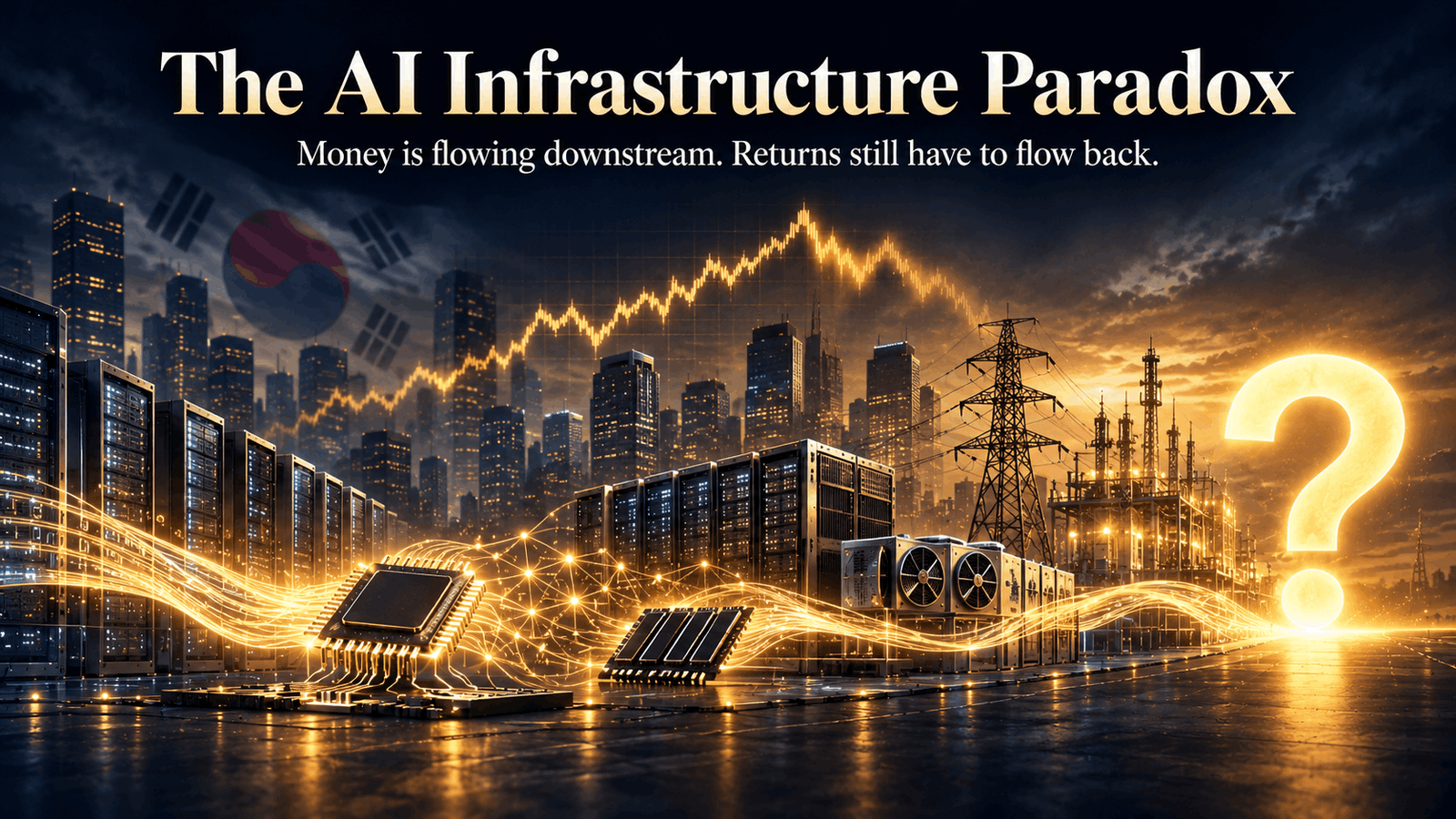
The AI Boom Meets Reality: What South Korea’s Market Crash Reveals About the Next Phase of Artificial Intelligence
SK Hynix should have been celebrating.
The South Korean memory-chip maker had just reported operating profits that were nearly six times higher than a year earlier, driven by unprecedented demand for the high-bandwidth memory (HBM) chips powering the global artificial intelligence boom. Samsung Electronics, another pillar of the country’s semiconductor industry, was also benefiting from record AI-related demand.
By almost every traditional measure, these were companies at the peak of their success.
Yet investors responded by doing the exact opposite of what the earnings suggested.
Within days, shares of Samsung and SK Hynix tumbled sharply, helping trigger one of the most severe sell-offs in South Korea’s stock market in years. The panic spread so quickly that trading was temporarily halted twice as authorities attempted to contain the wave of selling.
How can companies producing record profits lose hundreds of billions of dollars in market value?
The answer lies in one of the most important principles of investing: stock markets do not reward yesterday’s earnings—they price tomorrow’s expectations.
For much of the past two years, investors viewed artificial intelligence as an almost limitless growth story. Technology giants committed hundreds of billions of dollars to building AI data centres, chipmakers struggled to keep up with demand, and companies supplying the infrastructure behind AI became some of the biggest winners in global markets.
But every investment boom eventually reaches a point where investors stop asking, “How much are companies earning today?” and begin asking a far more difficult question: “Can these profits last?”
That shift in thinking is what turned South Korea’s stock market into the first major testing ground for the AI investment narrative.
The sell-off was not simply a reaction to disappointing share prices or temporary market volatility. It reflected growing doubts about whether the extraordinary spending on AI infrastructure can continue indefinitely, whether today’s record profits are sustainable, and whether an industry built on explosive demand could eventually face the same boom-and-bust cycle that has defined commodity markets for decades.
Understanding why South Korea’s markets fell so sharply is therefore about much more than one country’s stock market. It offers an early glimpse into the risks that could shape the next chapter of the global AI economy—and provides valuable lessons for investors navigating one of the biggest technological transformations of our time.
What Happened in South Korea?
The sell-off unfolded with remarkable speed.
Technology and semiconductor stocks had already been under pressure in the United States, where investors had begun reassessing the sustainability of the enormous investments being made in artificial intelligence infrastructure. As negative sentiment spread across global markets, South Korea—home to two of the world’s largest memory-chip manufacturers—became one of the hardest-hit markets.
The country’s benchmark Kospi Index fell by roughly 10% in a single trading session, marking one of its sharpest declines in years. The pace of the decline was so rapid that the Korea Exchange activated temporary trading halts twice, pausing trading in an effort to slow panic selling and restore orderly market conditions.
Among the biggest casualties were Samsung Electronics and SK Hynix, companies that have become central to the global AI supply chain. Samsung’s shares fell by around 12% during the sell-off, while SK Hynix dropped approximately 13%, despite both companies continuing to benefit from strong demand for AI-related memory chips.
The sharp decline surprised many investors because it came at a time when business fundamentals appeared exceptionally strong. SK Hynix had recently reported operating profits nearly six times higher than a year earlier, supported by soaring demand for high-bandwidth memory (HBM) used in advanced AI servers. Samsung also remained one of the world’s largest beneficiaries of the global surge in AI infrastructure spending.
The market reaction was not limited to institutional investors. South Korea has one of the world’s most active retail investing communities, with nearly 110 million stock trading accounts—roughly two accounts for every citizen. As share prices fell, many individual investors found themselves deeply underwater. According to one major brokerage, nearly half of Samsung investors were holding unrealized losses, while roughly 70% of SK Hynix investors were in the red.
Losses were magnified by the growing popularity of leveraged exchange-traded funds (ETFs), financial products designed to amplify the daily performance of an underlying stock or index. While these products can generate outsized gains during rising markets, they also accelerate losses when prices decline. Some leveraged ETFs linked to semiconductor stocks had already lost more than 60% of their value since launch, adding further pressure as markets weakened.
The severity of the sell-off prompted an unusually direct response from policymakers. South Korea’s Finance Minister publicly apologized for the market turmoil, acknowledging concerns that recently approved single-stock leveraged ETFs tied to companies such as Samsung and SK Hynix may have contributed to market volatility. The government subsequently announced plans to tighten oversight of these products, including proposals to limit investment amounts, increase trading costs, require simulated trading before investors can access leveraged ETFs, and prepare additional measures to stabilize markets during periods of extreme volatility.
By the end of the sell-off, trillions of won had been wiped from company valuations, and the episode had become far more than a domestic market correction. It had raised broader questions about whether investor confidence in the AI investment boom was beginning to shift.
The AI Infrastructure Boom That Created the Winners
To understand why South Korea’s semiconductor giants became some of the biggest casualties of the market sell-off, it is first necessary to understand why they had become some of its biggest winners.
The answer lies in an investment wave unlike anything the technology industry has witnessed in decades.
Since the emergence of generative artificial intelligence, the world’s largest technology companies—including Alphabet, Amazon, Meta Platforms, and Microsoft—have committed hundreds of billions of dollars to building the infrastructure needed to train and deploy increasingly powerful AI models. Across the industry, new data centres are being constructed at an unprecedented pace, filled with advanced graphics processing units (GPUs), high-speed networking equipment, storage systems, and specialised memory designed to handle enormous volumes of data.
This spending has created an entirely new investment cycle.
At its centre sits Nvidia, whose AI GPUs have become the industry’s most sought-after computing hardware. But every AI processor depends on another critical component: memory.
Modern AI servers require massive quantities of high-bandwidth memory (HBM), a specialised type of memory that allows GPUs to process vast amounts of information at extraordinary speeds. As AI models have become larger and more computationally intensive, demand for HBM has surged alongside demand for Nvidia’s chips.
That placed Samsung Electronics and SK Hynix in an exceptionally strong position.
Both companies are among the world’s leading producers of advanced memory chips, making them indispensable suppliers to the AI ecosystem. As cloud providers raced to expand their computing capacity, orders for high-performance memory accelerated, driving revenues and profits to record levels. For SK Hynix in particular, the AI boom translated into extraordinary financial results, with operating profits increasing nearly sixfold compared with the previous year.
For investors, the relationship appeared straightforward. As long as the world’s largest technology companies continued investing aggressively in AI infrastructure, demand for advanced memory chips would remain strong. Every new data centre, every additional AI server, and every GPU installed represented another source of revenue for memory manufacturers.
The optimism extended well beyond chipmakers. Across financial markets, AI infrastructure became one of the most compelling investment themes of the decade. Companies supplying processors, memory, networking equipment, power systems, cooling technologies, and data-centre construction all benefited from expectations that AI spending would continue rising for years to come.
Yet beneath the optimism lay an important assumption—that the pace of investment would remain extraordinarily high and that the demand created today would translate into sustainable profits tomorrow.
As long as investors believed that assumption, companies like Samsung and SK Hynix were rewarded with soaring earnings and strong valuations. The moment those assumptions began to be questioned, however, the market’s focus shifted from celebrating record profits to scrutinising whether the AI infrastructure boom could continue at its current pace.
Why Record Profits Weren’t Enough
On paper, the sell-off made little sense.
SK Hynix had just delivered one of the strongest earnings performances in its history. Samsung continued to benefit from robust demand for advanced memory chips. The AI infrastructure boom remained intact, and the world’s largest technology companies were still investing heavily in expanding their computing capacity.
Yet the market looked past all of it.
The reason is simple but fundamental: stock markets are not priced on what companies earned yesterday—they are priced on what investors believe companies will earn tomorrow.
When investors buy a share in a company, they are purchasing a claim on its future cash flows, not its past achievements. Strong earnings can certainly boost confidence, but they matter only if investors believe those profits can be sustained or grow over time. The moment that confidence weakens, even record financial results may no longer be enough to support a company’s valuation.
That is precisely what began to happen across the AI supply chain.
For nearly two years, investors had embraced a straightforward narrative. As long as artificial intelligence continued to reshape industries, technology companies would keep spending aggressively on AI infrastructure. More spending meant more data centres. More data centres meant more GPUs. More GPUs required more high-bandwidth memory, creating a powerful cycle that benefited companies such as Samsung and SK Hynix.
The market’s concern was not that this cycle had already ended. It was whether it could continue at the same extraordinary pace.
The companies leading the AI race—including Alphabet, Amazon, Meta Platforms, and Microsoft—have committed hundreds of billions of dollars to building AI infrastructure. Those investments have transformed the semiconductor industry, but they have also come at an enormous financial cost. Analysts increasingly expect some of these companies to generate negative free cash flow as capital expenditure rises faster than the cash their businesses produce.
For investors, that raises an uncomfortable question: how long can this level of spending continue before shareholders demand stronger financial returns?
If technology companies begin slowing their investment plans, the effects would extend far beyond the hyperscalers themselves. Demand for GPUs could moderate. Orders for high-bandwidth memory could weaken. Expansion of new AI data centres could slow. The companies that benefited most from the investment boom would also be the first to feel the impact of any slowdown.
Investors were also beginning to question the durability of long-term demand. Many AI infrastructure companies point to multi-year customer agreements as evidence that future revenue is secure. However, financial markets understand that contracts are not always permanent guarantees. If economic conditions change or expected returns from AI projects fall short, customers may delay deployments, renegotiate purchasing commitments, or scale back expansion plans. Markets therefore began pricing not today’s orders, but the possibility that tomorrow’s orders may not be as strong.
Another factor weighing on sentiment was the rapid pace of technological competition. The AI industry is evolving faster than almost any previous technology cycle. New open-source models, falling inference costs, and intensifying competition—particularly from Chinese AI developers—have raised expectations that AI capabilities will become more accessible and less expensive over time. If the economics of AI infrastructure become less attractive, companies may become more selective about future investment, reducing demand throughout the supply chain.
None of these risks had yet materialised in a meaningful way. AI spending remained historically high, semiconductor companies continued to report strong earnings, and demand for advanced memory chips had not collapsed.
But financial markets rarely wait for risks to become reality.
They continuously reassess the future, adjusting valuations whenever expectations change. The South Korean sell-off was therefore less a judgement on the profits companies had already earned than on the uncertainty surrounding the profits investors expected them to earn in the years ahead.
That distinction explains why some of the most profitable companies in the AI ecosystem nevertheless experienced some of the sharpest declines in their share prices. The market was no longer asking whether Samsung and SK Hynix had benefited from the AI boom. It was asking a more difficult question:
What happens if the boom begins to slow?
The Commodity Cycle: A Familiar Pattern Behind an Unprecedented Boom
Artificial intelligence may be reshaping the global economy, but one part of its supply chain has seen this story before.
Memory chips have long been one of the semiconductor industry’s most cyclical businesses.
Unlike highly differentiated products protected by unique software or powerful ecosystems, memory chips such as DRAM and NAND are largely interchangeable. Regardless of the manufacturer, a memory chip performs essentially the same function. As a result, competition is driven primarily by production capacity, manufacturing efficiency, and price rather than product differentiation.
That economic reality has repeatedly produced a familiar cycle.
When demand rises sharply, memory prices increase. Higher prices lead to exceptional profits, encouraging manufacturers to expand production capacity by investing billions of dollars in new fabrication plants. But these facilities take years to build. By the time additional capacity comes online, demand has often begun to slow. The market suddenly finds itself with more chips than customers need.
The result is oversupply.
Once supply exceeds demand, prices fall rapidly. Because memory chips compete largely on price, manufacturers have little ability to protect their margins. Profits shrink, investment slows, and weaker producers struggle to remain competitive. Eventually, production is reduced, supply tightens, and the cycle begins again.
This boom-and-bust pattern has shaped the memory industry for decades. Periods of extraordinary profitability have repeatedly been followed by sharp downturns, not because the technology became obsolete, but because success encouraged too much investment across the industry.
That historical experience helps explain why investors became uneasy despite today’s record earnings.
The current AI boom has created an unprecedented surge in demand for high-bandwidth memory (HBM), allowing companies such as Samsung and SK Hynix to generate exceptional profits. Yet investors understand that today’s shortages could eventually become tomorrow’s excess capacity if manufacturers continue expanding production while demand begins to normalise.
The concern extends beyond memory chips themselves.
Across the AI ecosystem, companies are investing enormous sums to build data centres, purchase GPUs, manufacture advanced semiconductors, and expand supporting infrastructure. As long as demand continues to grow at an extraordinary pace, these investments appear justified. But if spending slows—even modestly—the industry could face the same economic forces that have affected memory chips for decades: excess capacity, falling prices, and shrinking returns.
There is another reason investors are paying close attention. Competition is intensifying.
Chinese manufacturers have steadily increased their presence in the memory-chip market, placing additional pressure on established producers. At the same time, the broader AI industry is witnessing the rapid rise of increasingly capable open-source models and lower-cost alternatives. While these developments are expanding access to AI technologies, they also raise the possibility that parts of the AI value chain could become more competitive over time, reducing pricing power and compressing profit margins.
Importantly, this does not mean the AI revolution is coming to an end.
It means investors are beginning to distinguish between the long-term promise of artificial intelligence and the economics of the companies building its infrastructure. A transformative technology can continue changing the world while many of the businesses supporting it experience periods of oversupply, weaker pricing, and lower profitability.
That is the lesson history teaches.
The memory industry has repeatedly demonstrated that extraordinary profits often contain the seeds of future competition. The question investors are now asking is whether the AI infrastructure boom, despite its revolutionary nature, may eventually follow the same economic cycle.
Is AI Infrastructure Becoming the Next Commodity?
The concerns surrounding Samsung and SK Hynix extend beyond the memory industry. They raise a broader question that is becoming increasingly important for investors:
Could parts of the AI infrastructure ecosystem eventually become commoditized?
At first glance, the answer appears to be no.
Artificial intelligence remains one of the most advanced technologies ever developed. Training frontier AI models requires enormous computing power, sophisticated software, world-class engineering talent, and billions of dollars in capital. Companies such as Nvidia have built technological advantages that competitors cannot easily replicate, while the world’s largest cloud providers continue investing heavily to expand their AI capabilities.
Yet history suggests that even revolutionary technologies can become economically ordinary.
The internet transformed communication, but internet access eventually became a commodity. Cloud computing reshaped enterprise software, yet computing infrastructure became increasingly standardized over time. Smartphones revolutionized personal technology, but many hardware components ultimately competed on manufacturing efficiency and price rather than uniqueness.
Investors are now asking whether a similar process could unfold across parts of the AI ecosystem.
Today’s AI infrastructure boom is built on extraordinary demand for GPUs, advanced memory, networking equipment, and massive data centres. Nvidia’s processors have become the engine of this transformation, while companies such as Samsung and SK Hynix supply the high-bandwidth memory that allows those processors to perform increasingly complex AI workloads.
For now, demand continues to exceed supply.
But markets are already looking beyond today’s shortages.
As manufacturers expand production capacity and more suppliers enter the market, investors are beginning to consider whether the pricing power currently enjoyed by AI infrastructure companies can remain as strong in the years ahead. If supply grows faster than demand, competition could shift away from technological leadership and towards pricing, margins, and manufacturing scale—the defining characteristics of commodity industries.
The competitive landscape is already evolving.
Chinese semiconductor companies are investing heavily to strengthen domestic memory production, increasing competitive pressure on established manufacturers. At the same time, the software layer of the AI industry is becoming more competitive. Open-source AI models are improving rapidly, offering businesses lower-cost alternatives to proprietary systems. Advances in model efficiency and falling inference costs are making it possible to deploy increasingly capable AI systems using fewer computing resources than previously required.
These developments do not eliminate the need for AI infrastructure, but they could change its economics.
If AI models become cheaper to run, businesses may generate more AI output from existing hardware rather than continuously purchasing new infrastructure. If lower-cost competitors narrow the technology gap, suppliers may find it harder to sustain today’s exceptionally high margins. And if customers become more price-sensitive as the market matures, long-term profitability could depend less on scarcity and more on operational efficiency.
That is why investors are looking beyond quarterly earnings.
The key question is no longer whether demand for AI exists. It clearly does.
The more difficult question is whether the extraordinary profits currently earned across parts of the AI supply chain represent a durable competitive advantage or simply the early stage of an industry that will become increasingly competitive as technology matures.
For companies such as Samsung and SK Hynix, this distinction is critical. Their recent share-price declines were not a verdict on today’s business performance. Rather, they reflected growing uncertainty over what the AI infrastructure market will look like once supply catches up, competition intensifies, and the industry’s exceptional growth begins to normalize.
In many ways, this is the transition every transformative technology eventually faces. Innovation creates scarcity. Scarcity creates extraordinary profits. Those profits attract investment and competition. Over time, competition reshapes the economics of the industry.
The AI revolution may still be in its early chapters. But financial markets are already trying to determine what the final chapter of its business model might look like.
When Psychology Meets Leverage
Financial markets rarely move on fundamentals alone.
Corporate earnings, cash flows, and economic data determine a company’s long-term value, but short-term market movements are often driven by something far less predictable: human psychology.
The South Korean sell-off illustrates how quickly investor sentiment can shift once confidence begins to crack.
For more than two years, artificial intelligence had become one of the world’s most compelling investment themes. Every new AI model, every major data-centre announcement, and every increase in technology companies’ capital spending reinforced the belief that AI-related businesses would continue growing for years. Semiconductor companies, particularly those supplying the AI supply chain, became some of the market’s most popular investments.
Success attracted even more investors.
South Korea already has one of the world’s highest levels of retail market participation, with nearly 110 million stock trading accounts—roughly two for every citizen. As AI-related shares continued to rise, many individual investors entered the market, believing they were participating in the next major technological revolution.
This is a common feature of every investment boom.
Rising prices create optimism. Optimism attracts new investors. New buying pushes prices even higher, reinforcing the belief that the original investment thesis is correct. Economists and behavioural finance researchers often describe this as a feedback loop in which investor enthusiasm fuels further gains, encouraging even greater participation.
The cycle becomes significantly more dangerous when leverage enters the picture.
Instead of simply buying shares, many investors sought to increase their potential returns by borrowing money or purchasing leveraged exchange-traded funds (ETFs). These products are designed to amplify the daily movement of an underlying stock or index. A fund offering two-times leverage, for example, aims to deliver roughly twice the daily gain—or twice the daily loss—of the asset it tracks.
The mathematics are straightforward, but the consequences can be severe.
A modest decline in the underlying shares can translate into much larger losses for leveraged investors. As losses mount, brokers may require investors to deposit additional funds to maintain their positions—a process known as a margin call. Investors who cannot provide additional capital are often forced to sell their holdings, regardless of whether they still believe in the long-term prospects of the companies they own.
That forced selling creates another feedback loop.
Sales push prices lower. Lower prices trigger additional margin calls. More investors are forced to sell, adding further downward pressure to the market. What may have begun as a reassessment of future earnings can rapidly evolve into a broad market sell-off driven by liquidity rather than fundamentals.
The South Korean market exhibited many of these characteristics.
As semiconductor shares declined, leveraged products magnified investor losses. Some single-stock leveraged ETFs linked to major chipmakers had already fallen by more than 60% since their launch, highlighting how quickly amplified exposure can reverse when market sentiment changes. According to one major brokerage, nearly half of Samsung investors and around 70% of SK Hynix investors were holding unrealised losses during the sell-off, increasing the emotional and financial pressure on retail participants.
Recognising these risks, policymakers concluded that leverage itself had become part of the problem. The government’s decision to review single-stock leveraged ETFs, tighten investment rules, and require simulated trading before allowing access to these products reflected a broader concern that financial innovation had amplified market volatility rather than merely providing investors with additional choice.
The lesson extends far beyond South Korea.
Every major investment boom is driven by two powerful forces. The first is a compelling technological or economic story. The second is human psychology. The story attracts investors. Rising prices reinforce belief. Leverage magnifies both gains and losses. When confidence eventually weakens, the same forces that accelerated the rise can accelerate the decline.
The South Korean sell-off was therefore not simply a story about semiconductors or artificial intelligence. It was also a reminder that markets do not move in straight lines. Even the strongest long-term investment themes can experience sharp and painful corrections when optimism, leverage, and changing expectations collide.
When Markets Become a Policy Problem
By the time South Korea’s government stepped in, the issue was no longer just falling share prices.
The concern had become the stability of the market itself.
Stock market corrections are a normal feature of financial markets, and governments rarely intervene simply because investors are losing money. Policymakers become involved when they believe that the structure of the market is amplifying volatility in ways that could threaten financial stability or undermine confidence in the financial system.
That is the point South Korea appeared to reach.
As semiconductor shares declined, leveraged investment products magnified losses and accelerated selling pressure. Instead of acting as passive investment vehicles, some single-stock leveraged exchange-traded funds (ETFs) intensified daily price movements by delivering multiples of the gains—and the losses—of individual companies. What might have been an orderly market correction risked becoming a self-reinforcing cycle of forced selling.
For regulators, this raised an uncomfortable question.
Had financial innovation made the market more efficient, or had it simply made periods of stress more volatile?
The debate was particularly significant because these leveraged products had only recently been approved. Their growing popularity allowed investors to take increasingly concentrated positions in companies such as Samsung Electronics and SK Hynix with relatively small amounts of capital. While these products offered the potential for amplified returns during the AI boom, they also increased the speed at which losses could spread once sentiment turned.
Recognising those risks, South Korea’s Finance Minister publicly apologised for the market turmoil and acknowledged concerns that single-stock leveraged ETFs may have contributed to the severity of the sell-off. The government subsequently announced plans to tighten oversight of these products by limiting investment exposure, increasing trading costs, requiring investors to complete simulated trading before using leveraged ETFs, and preparing additional measures to stabilise markets during periods of extreme volatility.
These proposals were not intended to prevent investors from taking risks.
Rather, they reflected a broader regulatory principle: financial markets function best when investors understand the risks they are assuming and when market structures do not amplify volatility beyond what underlying fundamentals justify.
The episode also highlights a broader shift taking place around the world.
Artificial intelligence is no longer simply a technological race between private companies. It is increasingly becoming a policy issue. Governments are already competing to attract semiconductor manufacturing, subsidising domestic chip production, strengthening export controls, investing in AI infrastructure, and developing rules for advanced AI systems. As the economic importance of AI continues to grow, financial stability is becoming another area where policymakers are likely to play a more active role.
The South Korean response illustrates this evolution.
What began as a sharp decline in semiconductor stocks quickly expanded into a discussion about financial regulation, investor protection, and the resilience of markets during periods of technological transformation. In that sense, the government’s intervention was not merely a reaction to one volatile trading week. It reflected a recognition that the AI economy is becoming deeply intertwined with national financial systems, making the risks surrounding AI investment not only a concern for investors, but increasingly a concern for policymakers as well.
The AI Infrastructure Paradox
Every technological revolution creates winners.
The AI revolution has certainly done that.
Nvidia has become one of the world’s most valuable companies. Samsung and SK Hynix have reported record demand for advanced memory chips. Manufacturers of networking equipment, cooling systems, electrical infrastructure, and semiconductor production equipment have all benefited from an unprecedented wave of investment.
Yet beneath these success stories lies a paradox that may define the next stage of the AI economy.
The companies selling AI infrastructure are generating extraordinary profits.
The companies buying that infrastructure are spending extraordinary amounts of money.
For now, both sides appear to be winning.
But that cannot continue indefinitely.
The world’s largest technology companies—including Microsoft, Amazon, Alphabet, and Meta Platforms—are investing hundreds of billions of dollars in AI data centres, advanced chips, networking equipment, and supporting infrastructure. These investments are expected to put significant pressure on free cash flow as capital expenditure grows faster than the cash generated by their operations.
Meanwhile, much of that spending is flowing through the AI supply chain.
Every new AI data centre requires Nvidia’s GPUs.
Every GPU requires advanced high-bandwidth memory supplied by companies such as Samsung and SK Hynix.
Building these facilities also creates demand for semiconductor manufacturing equipment, networking hardware, power infrastructure, cooling systems, construction services, and electricity.
In other words, capital is flowing rapidly through the AI ecosystem.
The current investment cycle can be visualised as follows:
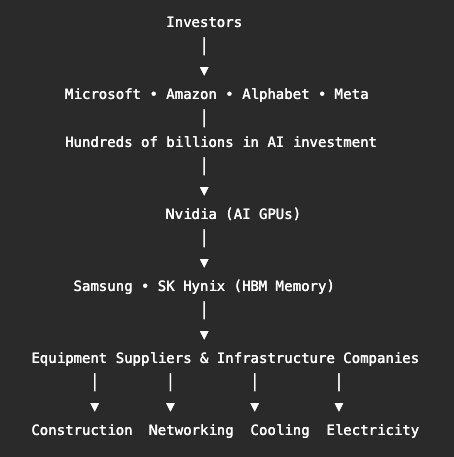
Notice what is happening.
Cash is flowing downstream through the supply chain.
Hyperscalers invest in AI infrastructure.
Infrastructure suppliers record higher revenues.
Chip manufacturers report record profits.
Equipment companies receive more orders.
Everyone involved in building the AI ecosystem benefits from the surge in capital expenditure.
But there is one crucial question that remains unanswered.
Where does the money flow back?
Eventually, the companies making these enormous investments must generate sufficient economic returns from AI products and services to justify the capital they have deployed. The infrastructure build-out cannot remain an end in itself. It must ultimately translate into sustainable revenue, durable cash flows, and attractive returns for shareholders.
This is the question financial markets are beginning to ask.
If AI applications continue creating significant economic value, today’s investment boom may prove entirely justified.
If monetisation proves slower than expected, however, companies may become more selective with future spending. That would ripple through the entire supply chain—from data-centre construction and electricity providers to Nvidia, Samsung, SK Hynix, and countless other businesses that have benefited from the current investment cycle.
This is why the South Korean market correction matters.
It was not simply a reaction to semiconductor earnings.
It was one of the first signs that investors are beginning to distinguish between building AI infrastructure and earning sustainable returns from AI.
The first phase of the AI revolution was defined by a race to build.
The next phase may be defined by a race to monetise.
The companies that succeed will not necessarily be those that spend the most, but those that prove artificial intelligence can generate durable economic value commensurate with the trillions of dollars now being invested across the global technology ecosystem.
Lessons for Investors
The South Korean market sell-off was more than a correction in semiconductor stocks. It was a reminder that technological revolutions and financial markets do not always move in the same direction. While artificial intelligence continues to transform industries, the events surrounding Samsung and SK Hynix offer several broader lessons that extend far beyond one country or one sector.
- Strong Companies Do Not Always Make Strong Investments
One of the most counterintuitive lessons from the sell-off is that exceptional business performance does not automatically translate into rising share prices.
SK Hynix reported operating profits nearly six times higher than a year earlier, while Samsung continued to benefit from strong demand for AI memory chips. Yet both companies experienced sharp declines in their market value.
The reason is that investors buy future earnings, not historical results. A company can execute exceptionally well, but if markets believe future growth will slow or risks are increasing, its valuation can still fall. Understanding this distinction is essential for anyone investing in high-growth industries. - Markets Price Expectations, Not Headlines
Financial markets constantly look ahead.
By the time impressive earnings are announced, investors have often already incorporated those expectations into share prices. What ultimately matters is whether reality exceeds, meets, or falls short of what the market had anticipated.
In South Korea, the market’s attention shifted away from record profits and towards a more difficult question: could the AI investment boom continue at its current pace? That change in expectations—not weaker earnings—was enough to trigger a significant repricing of semiconductor stocks. - Capital-Intensive Industries Eventually Face the Challenge of Oversupply
History shows that periods of extraordinary profitability often encourage extraordinary investment.
When prices are high and demand appears limitless, companies naturally expand production capacity. The risk is that new capacity frequently arrives just as demand begins to moderate, creating excess supply and putting pressure on prices and profit margins.
The memory-chip industry has experienced this cycle repeatedly over the past several decades. Investors are now asking whether parts of today’s AI infrastructure build-out could eventually face similar economic pressures if investment continues to outpace long-term demand. - Leverage Amplifies Both Confidence and Fear
Leverage is often described as a tool for increasing returns. In reality, it also increases vulnerability.
Borrowing money to invest or purchasing leveraged ETFs can significantly magnify gains during rising markets. But when prices begin to fall, those same products can accelerate losses, trigger margin calls, and force investors to sell at precisely the wrong time.
The South Korean sell-off demonstrated how leverage can transform a market correction into a much sharper decline by reinforcing panic rather than absorbing it. - Revolutionary Technologies Are Still Subject to Economic Cycles
Artificial intelligence may prove to be one of the defining technologies of the twenty-first century. That does not mean every company participating in the AI ecosystem will enjoy uninterrupted growth.
History offers numerous examples of transformative innovations—from railways and automobiles to the internet—that changed the world while many companies operating within those industries experienced periods of overinvestment, intense competition, and disappointing shareholder returns.
Technological progress and attractive investment returns are related, but they are not the same thing. - The Greatest Risks Often Emerge at the Peak of Optimism
Perhaps the most important lesson is psychological.
The most dangerous moment in any investment cycle is often not when fear dominates the market, but when optimism becomes almost universal.
During periods of euphoria, investors become increasingly confident that current trends will continue indefinitely. Companies invest aggressively, valuations expand, leverage increases, and risk-taking becomes more common. The longer optimism persists, the less attention markets pay to the possibility that conditions could eventually change.
The South Korean correction serves as a reminder that markets rarely reverse because a business suddenly becomes weak. More often, they reverse because expectations become too optimistic to sustain.
The events in South Korea do not prove that the AI boom is ending. Nor do they suggest that demand for artificial intelligence will disappear. What they demonstrate is something more subtle but equally important: even the most transformative technologies remain governed by the fundamental principles of economics, competition, valuation, and human psychology.
For long-term investors, that may be the most valuable lesson of all.
What This Means for the AI Industry
The events in South Korea should not be interpreted as evidence that the artificial intelligence boom is over.
If anything, they illustrate how rapidly the industry has matured.
Only a few years ago, the central question surrounding AI was whether the technology would live up to its promise. Today, that debate has largely shifted. Businesses are deploying AI at scale, governments are developing national AI strategies, and the world’s largest technology companies are investing hundreds of billions of dollars to build the infrastructure required for increasingly powerful models.
The question is no longer whether AI matters.
The question is whether the economics of today’s investment boom can ultimately justify its extraordinary cost.
That is the challenge now confronting the industry’s biggest investors.
For the past two years, Alphabet, Amazon, Meta Platforms, and Microsoft have been engaged in an unprecedented race to build AI infrastructure. New data centres, advanced GPUs, specialised memory, networking equipment, and energy infrastructure have become the foundations of a global technology build-out unlike anything seen since the expansion of the internet.
These investments have produced clear winners. Nvidia has become one of the world’s most valuable companies. Samsung and SK Hynix have reported record demand for advanced memory chips. Equipment suppliers, networking companies, and data-centre developers have all benefited from the rapid expansion of AI infrastructure.
Yet history suggests that every infrastructure boom eventually reaches a turning point.
The defining question is no longer how quickly companies can build AI systems. It is whether those systems can generate economic returns that justify the capital being invested.
At some point, investors will expect the industry’s focus to shift from building capacity to generating sustainable cash flows.
That transition will not necessarily be dramatic, nor will it happen on a single date. It is more likely to unfold gradually as corporate boards, shareholders, and financial markets begin asking increasingly disciplined questions.
Can hyperscalers continue increasing capital expenditure at its current pace, or will investment become more selective?
Will demand for AI infrastructure continue to accelerate, or will spending begin to normalize as existing capacity is more fully utilized?
Can companies such as Nvidia maintain today’s exceptional growth rates as competitors emerge and customers seek greater efficiency?
Will advances in model efficiency, falling inference costs, and increasingly capable open-source AI models reduce the amount of infrastructure required to deliver new AI applications?
Most importantly, can the AI industry generate enough long-term economic value to justify the trillions of dollars now being committed across the global technology ecosystem?
These are not signs of weakness.
They are the questions that naturally arise whenever a transformative technology moves from its infrastructure phase to its commercialization phase.
History offers a useful comparison.
During the early expansion of the internet, investors focused primarily on building networks, laying fibre-optic cables, constructing data centres, and connecting users. Eventually, attention shifted away from infrastructure itself and towards the businesses capable of generating sustainable profits from that infrastructure. Some companies thrived during that transition. Others discovered that building the foundation of a technological revolution does not always guarantee attractive long-term returns.
Artificial intelligence may now be approaching a similar moment.
The next chapter of the AI economy is unlikely to be defined solely by who builds the most computing capacity. Increasingly, it may be defined by who can transform that capacity into durable businesses, resilient cash flows, and products that customers are willing to pay for over many years.
That is why the South Korean market correction deserves attention far beyond Seoul.
It was not simply a story about falling semiconductor stocks. It was one of the first indications that financial markets are beginning to look beyond the excitement of building AI and towards the harder question of earning sustainable returns from it.
The infrastructure race has captured the world’s attention.
The monetization race may determine who ultimately wins.