The Hidden Cost of the AI Boom: Can the World Sustain the Data Centre Revolution?
Imagine building a facility that consumes enough electricity to power nearly one million homes. That is exactly what Meta is doing with its Prometheus AI data centre in Ohio—a massive complex that will require around one gigawatt of power to train and run next-generation artificial intelligence models. And it is only one of many such projects underway. Technology giants including Amazon, Google, Microsoft, Oracle, and Meta are investing hundreds of billions of dollars in hyperscale data centres as the global race for AI accelerates, with worldwide investment expected to reach trillions of dollars over the rest of this decade.
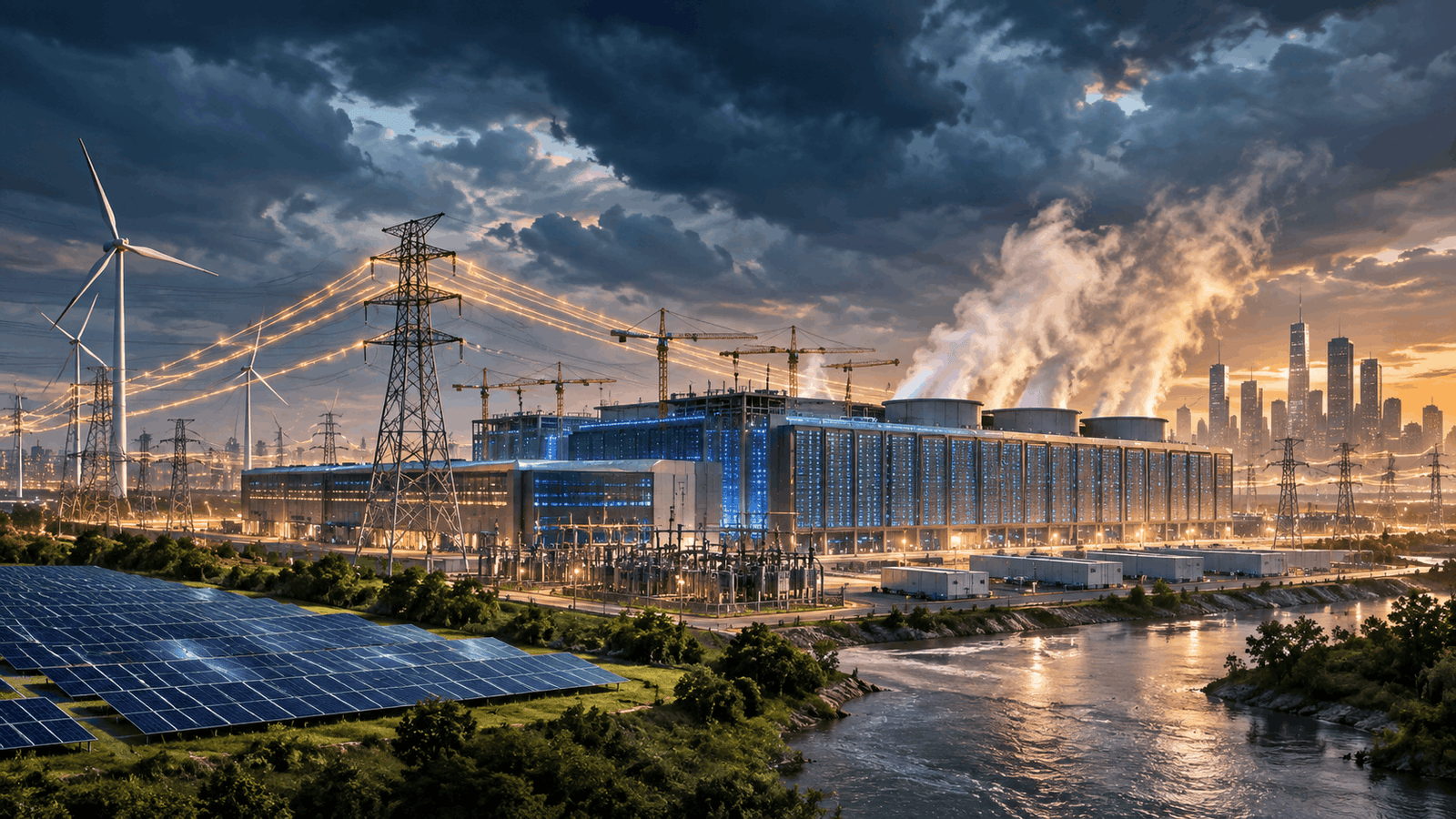
For most people, AI exists only on a screen. A prompt is typed into ChatGPT, an image is generated in seconds, or an AI assistant writes code almost instantly. The experience feels entirely digital. Yet behind every AI-generated response lies a vast physical network of semiconductor chips, server racks, cooling systems, power plants, transmission lines, water infrastructure, and sprawling data centres operating around the clock. AI is no longer just software—it has become one of the world’s fastest-growing infrastructure industries.
The scale of this transformation is becoming impossible to ignore. According to the United Nations University, global data centres consumed 448 terawatt-hours of electricity in 2025—more than the annual electricity consumption of Saudi Arabia—and used 4.5 trillion litres of water. By 2030, both electricity and water consumption are expected to roughly double, while carbon emissions and the physical footprint of data centres will rise sharply as AI accounts for an ever-larger share of global computing demand.
These growing demands are forcing governments, utilities, businesses, and local communities to confront difficult questions. Can electricity grids keep pace with AI’s appetite for power? How will regions already facing water shortages accommodate water-intensive cooling systems? Should more fossil fuel plants remain online to support AI, or can clean energy scale fast enough? And how should policymakers balance the economic promise of AI against its environmental costs?
The AI revolution is no longer just about algorithms, models, or software. It is becoming an infrastructure revolution—one that is reshaping energy systems, water resources, industrial policy, and the future of sustainable economic growth.
Why AI Needs So Many Data Centres
Artificial intelligence may appear effortless from the user’s perspective. A question typed into ChatGPT is answered within seconds, an image is generated almost instantly, and an AI assistant can write code or summarize a report in moments. Behind this seamless experience, however, lies one of the largest computing infrastructures ever built.
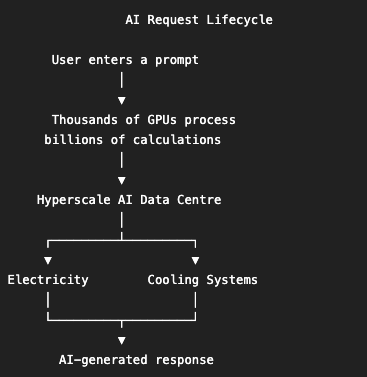
Unlike traditional software, modern AI models perform billions of mathematical calculations for every interaction. These calculations cannot be handled by ordinary computer processors alone. Instead, they require thousands of highly specialized graphics processing units (GPUs) working together inside hyperscale data centres.
Training AI: Teaching Machines to Learn
Before an AI model can answer questions or generate images, it must first be trained.
Training is the process of exposing an AI model to enormous datasets—including books, research papers, websites, images, videos, and software code—so that it can recognize patterns and relationships. During this stage, the model repeatedly adjusts billions, and in some cases trillions, of internal parameters until it can accurately predict the next word, recognize objects, generate images, or solve complex problems.
This is an extraordinarily compute-intensive process. Training a frontier AI model can take weeks or even months, requiring tens of thousands of GPUs operating simultaneously. According to research cited in the source material, a single next-generation frontier model could require as much as 5 gigawatts (GW) of computing power by 2028 and up to 16 GW by 2030—more electricity than many countries consume.
Inference: The Hidden Cost of Every Prompt
Training receives much of the attention, but it is inference—the process of generating responses after a model has been trained—that consumes most of AI’s electricity.
Every time a user asks ChatGPT a question, requests an image, translates a document, or asks an AI assistant to write code, thousands of GPUs perform millions of calculations to produce the response in real time.As AI adoption expands across search engines, enterprise software, smartphones, healthcare, finance, and education, these requests are growing into the billions each day. The United Nations University estimates that around 90% of AI’s electricity consumption comes from inference rather than training, with ChatGPT alone processing approximately 2.5 billion prompts every day.
Why AI Needs GPUs Instead of Traditional CPUs
Conventional processors (CPUs) are designed to execute tasks sequentially and are well suited for everyday computing such as web browsing or word processing.
AI workloads are fundamentally different. They require billions of calculations to be performed simultaneously. GPUs were originally developed for rendering computer graphics, but their ability to execute thousands of parallel operations makes them ideally suited for training and running large language models. As a result, modern AI data centres contain tens of thousands of GPUs connected through ultra-high-speed networking, creating what is effectively a single giant supercomputer.
The Rise of Hyperscale Data Centres
Housing this level of computing power requires infrastructure on an unprecedented scale.
Today’s hyperscale AI data centres are no longer simple server buildings. They are industrial campuses equipped with massive GPU clusters, advanced liquid and air cooling systems, dedicated electrical substations, backup power generation, and high-capacity fibre-optic networks. Many occupy hundreds of acres and consume enough electricity to power entire cities.
Technology companies are investing hundreds of billions of dollars in these facilities because existing computing capacity is already proving insufficient. Demand for AI services has grown so quickly that some providers have limited access to advanced models, discontinued compute-intensive features, or raised prices while waiting for new data centres to come online.
Ultimately, every AI-generated response begins long before a user types a prompt. It starts with a vast physical ecosystem of semiconductor chips, servers, electricity grids, cooling systems, and data centres working together around the clock. Understanding this infrastructure is essential to understanding why the rapid expansion of AI is creating new challenges for energy systems, water resources, and the environment.
The Environmental Cost Nobody Saw Coming
The artificial intelligence boom is often described in digital terms—algorithms, chips, cloud computing and software. Yet AI is becoming one of the most resource-intensive industries in the modern economy. Every chatbot response, generated image and AI-powered search depends on physical infrastructure that consumes electricity, water, land and raw materials on an unprecedented scale.
As governments and technology companies race to build ever larger data centres, the environmental footprint of AI is expanding alongside its computational capability. Much of this cost remains largely invisible to users. Unlike factories or power plants, data centres operate quietly behind the scenes. Yet their demand for energy, cooling and specialised hardware is reshaping electricity grids, water resources and industrial supply chains around the world.
The environmental debate surrounding AI is therefore no longer simply about emissions. It is increasingly about whether societies can provide the physical resources required to sustain the industry’s extraordinary growth.
Electricity: AI’s Largest Resource Requirement
Electricity has become the defining constraint of the AI revolution.
Training frontier AI models requires thousands of high-performance GPUs operating continuously for weeks or months. Once deployed, those same models continue consuming electricity every time users interact with them. As AI adoption accelerates, inference—the process of generating responses for millions of users—is expected to consume almost as much computing power as model training itself.
The result is an unprecedented increase in electricity demand from data centres.
According to the International Energy Agency (IEA), global data centres currently consume approximately 448 terawatt-hours (TWh) of electricity annually—roughly equivalent to the total electricity consumption of a medium-sized industrialised nation. By 2030, that figure is projected to rise to around 945 TWh, more than doubling within a decade.
Artificial intelligence is becoming the primary driver of that growth. AI workloads currently account for roughly one-fifth of data-centre electricity demand, but that share is expected to approach 40 per cent by the end of the decade as AI models become larger and adoption becomes more widespread.
This shift represents more than rising electricity consumption. It fundamentally changes how power systems operate. Unlike many industrial facilities, hyperscale AI data centres require uninterrupted electricity around the clock. Even brief power interruptions can disrupt computing clusters worth billions of dollars. Consequently, utilities are increasingly being asked to deliver enormous amounts of highly reliable electricity to individual facilities—often on timescales much shorter than traditional grid expansion projects.
Electricity is therefore emerging as one of the industry’s most significant bottlenecks.
Water: The Hidden Cooling Challenge
Electricity powers AI, but water keeps it running.
Modern AI servers generate enormous amounts of heat. A single rack of advanced GPUs can consume tens of kilowatts of power, producing enough heat that conventional air conditioning is often insufficient. Data centres therefore rely on sophisticated cooling systems that transfer heat away from processors before they overheat.
Many of these systems depend on evaporative cooling, where water absorbs heat before evaporating into the atmosphere. While highly effective, the process requires substantial quantities of freshwater, particularly during periods of high temperatures.
Unlike electricity consumption, water use is highly local. A large data centre may have little impact on a region with abundant water resources but can place significant pressure on communities already experiencing water scarcity. Several technology companies have faced growing scrutiny for expanding data-centre capacity in drought-prone regions where freshwater is already under increasing demand from agriculture, households and industry.
The scale of this challenge is becoming increasingly apparent. By the end of the decade, global water withdrawals associated with AI-related data centres are projected to reach levels comparable to the annual freshwater consumption of entire nations. Some estimates suggest that AI infrastructure could require volumes of water approaching the yearly use of countries such as Africa’s smaller nations collectively, illustrating how a seemingly digital industry can generate very real environmental pressures.
As AI computing expands, access to reliable water resources may become almost as strategically important as access to electricity.
Carbon Emissions: Why AI Is Not Automatically Green
Technology companies frequently highlight their investments in renewable energy. Many have signed large solar and wind power agreements and committed to ambitious net-zero targets.
Yet powering AI presents challenges that renewable energy alone cannot fully solve.
Wind and solar generation fluctuate with weather conditions, while AI data centres require continuous electricity twenty-four hours a day. Until energy storage technologies become significantly more widespread, utilities often rely on natural gas or other fossil-fuel generation to provide stable backup power whenever renewable generation falls short.
In some regions, utilities are extending the operating lives of existing gas-fired power stations or proposing new generation capacity specifically to meet rapidly rising data-cententre demand. Although renewable energy continues to expand rapidly, grid infrastructure often cannot be built quickly enough to keep pace with AI’s accelerating electricity requirements.
Consequently, AI is not inherently a low-carbon technology. Its environmental impact depends largely on the carbon intensity of the electricity supplying each data centre. An AI model running in a region dominated by renewable or nuclear power may generate substantially lower emissions than the same model operating in a grid heavily dependent on fossil fuels.
The industry’s carbon footprint is therefore determined not simply by advances in artificial intelligence, but by the pace of the global energy transition.
Land: Building the Physical Infrastructure of AI
The AI boom is transforming landscapes as well as electricity grids.
Modern hyperscale data centres are no longer isolated warehouse-style buildings. They are sprawling industrial campuses covering hundreds of acres and containing multiple computing halls, substations, cooling infrastructure and backup power systems.
Supporting these facilities requires extensive investment beyond the data centre itself. New high-voltage transmission lines must connect campuses to electricity networks. Utilities must construct additional substations capable of delivering hundreds of megawatts of power. Roads, fibre-optic networks and water infrastructure frequently need to be expanded to accommodate new developments.
Entire industrial zones are now emerging around major AI clusters, particularly in regions with abundant land, reliable electricity and favourable regulatory environments.
What appears to users as a cloud-based service increasingly depends on an expanding network of highly specialised physical infrastructure.
Electronic Waste: The Next Sustainability Challenge
AI’s environmental footprint extends beyond electricity and water. It also includes the rapid turnover of specialised computing hardware.
Unlike traditional enterprise servers, AI infrastructure relies on cutting-edge GPUs, high-speed networking equipment, advanced cooling systems and specialised storage technologies that evolve at extraordinary speed. Each new generation delivers substantial improvements in performance, encouraging operators to replace existing hardware long before it reaches the end of its physical lifespan.
This accelerated replacement cycle generates growing volumes of electronic waste.
Retired servers contain valuable materials such as copper, aluminium and rare earth elements, alongside components that require specialised recycling to prevent environmental contamination. Cooling equipment, power electronics and networking hardware add further complexity to responsible disposal.
As AI competition intensifies, hardware upgrade cycles are likely to become even shorter. The challenge for policymakers and technology companies will not simply be manufacturing enough advanced chips, but ensuring that yesterday’s AI infrastructure can be responsibly reused, refurbished or recycled.
The Hidden Cost of Intelligence
Artificial intelligence may exist in software, but it depends entirely on physical resources.
Every improvement in AI capability requires more computing power, more electricity, more cooling, more specialised hardware and more supporting infrastructure. These environmental costs do not imply that AI should be slowed or abandoned. Rather, they illustrate that the digital economy is becoming increasingly constrained by physical realities.
The AI revolution is not only a story about algorithms. It is also a story about energy systems, water resources, industrial infrastructure and the planet’s finite capacity to support them.
The Social Cost of the AI Infrastructure Boom
The artificial intelligence revolution is often portrayed as a competition between technology companies and nations racing to build the computing infrastructure needed for the next generation of AI. Less attention is paid to another group whose lives are increasingly being shaped by that race: the communities where these facilities are built.
Unlike software, data centres occupy physical space. They require large parcels of land, high-voltage electricity connections, water infrastructure and transport links. As construction accelerates, many communities are discovering that the digital economy has a tangible local footprint. Across the United States and Europe, proposals for new AI data centres are increasingly meeting organised public opposition, transforming what was once viewed as routine industrial development into a growing political issue.
The debate is no longer simply about technology. It is about who bears the costs of enabling the AI economy.
When Data Centres Become Neighbours
Modern hyperscale data centres are among the largest industrial facilities being built today. While they operate quietly from the perspective of internet users, their presence can significantly alter the surrounding landscape.
Residents often raise concerns over constant noise from cooling equipment, diesel backup generators and electrical substations that operate around the clock. Others object to the visual transformation of rural or suburban areas as warehouse-sized buildings, transmission towers and security fencing replace open land. Large developments may also increase traffic during construction and place additional pressure on local infrastructure.
Unlike factories or office parks, data centres generally employ relatively few permanent workers once construction is complete. For some communities, this has fuelled questions over whether the economic benefits justify the environmental and social impacts.
These concerns have become increasingly visible as AI companies search for locations capable of supporting ever larger computing campuses.
A Growing Backlash Across the United States
Community resistance is no longer confined to isolated disputes. It is emerging across several of America’s fastest-growing data-centre markets.
In Virginia—already home to the world’s largest concentration of data centres—residents have challenged proposals over concerns about noise, landscape changes, electricity demand and pressure on public infrastructure. Local planning meetings have increasingly become venues for debates over whether continued expansion remains compatible with residents’ quality of life.
Similar tensions have appeared in Ohio, where several large-scale developments have faced organised opposition from residents worried about land use, environmental impacts and the long-term character of their communities. While local governments often welcome investment and additional tax revenues, nearby residents have questioned whether the benefits are distributed evenly.
In Michigan, proposed facilities have sparked debates over zoning decisions, infrastructure requirements and the conversion of agricultural or undeveloped land into industrial sites. Discussions that once focused primarily on economic development now increasingly include questions about sustainability, community identity and long-term planning.
Texas, another rapidly expanding AI infrastructure hub, has experienced similar disputes. Rapid development has generated concerns over electricity demand, water availability and the cumulative impact of multiple large data-centre projects being concentrated within the same regions.
Although each community faces different circumstances, the underlying issues are remarkably similar: balancing economic opportunity against environmental pressures and changes to local living conditions.
The Politics of AI Infrastructure
As data-centre construction accelerates, local planning decisions are becoming increasingly political.
Municipal councils and county governments now find themselves weighing competing priorities. Technology companies promise billions of dollars in investment, construction jobs and expanded tax bases. Residents, meanwhile, often seek stronger protections for neighbourhood character, natural resources and public infrastructure.
These competing interests have, in some cases, delayed approvals, triggered legal challenges or resulted in projects being scaled back or cancelled altogether. What was once considered a largely technical planning exercise is becoming a broader debate about land use, environmental governance and community consent.
The politics surrounding AI infrastructure also reflect a wider tension. National governments increasingly regard AI computing capacity as a strategic asset linked to economic competitiveness and technological leadership. Local communities, however, experience the immediate consequences of hosting that infrastructure. The benefits may be national, but many of the costs remain local.
The Next Infrastructure Challenge
Every major technological transformation has required new physical infrastructure. Railways reshaped towns, highways divided neighbourhoods and power stations altered landscapes. AI data centres are becoming the latest example of this historical pattern.
The challenge is not whether societies should build the infrastructure needed for artificial intelligence. The demand for computing capacity is unlikely to diminish. Rather, the question is how that infrastructure can be developed in ways that balance technological progress with the interests of the communities expected to host it.
As AI becomes increasingly central to the global economy, public acceptance may prove just as important as advances in chips or software. Building the future of artificial intelligence will require more than engineering expertise. It will also require political legitimacy, community engagement and public trust.
Why Governments Cannot Simply Say No
If AI data centres consume enormous amounts of electricity, strain water supplies and increasingly face resistance from local communities, an obvious question follows: why do governments continue approving them?
The answer lies in the changing role of artificial intelligence itself. AI is no longer viewed simply as another technology sector. It is increasingly regarded as critical national infrastructure—comparable to electricity networks, ports or telecommunications. Governments now see AI capability as essential not only for economic growth but also for national security, technological competitiveness and geopolitical influence.
The challenge facing policymakers is therefore one of trade-offs. Restricting data-centre development may reduce environmental pressures in the short term, but it could also weaken a country’s position in one of the world’s fastest-growing strategic industries.
The debate is no longer about whether AI should expand. It is about where that expansion will occur and which countries will benefit from it.
AI Leadership Has Become an Economic Strategy
Artificial intelligence is rapidly becoming one of the defining technologies of the twenty-first century. Countries that host AI infrastructure stand to capture far more than data-centre investment. They position themselves within an ecosystem that includes semiconductor manufacturing, cloud computing, software development, advanced research and high-value digital services.
Large data centres attract suppliers, engineering firms, network operators and energy developers. They stimulate demand for construction, electrical equipment, cooling technologies and specialised manufacturing. Over time, these investments can create clusters of expertise that encourage further innovation and private investment.
For governments seeking long-term economic growth, AI infrastructure is therefore viewed not as an isolated project but as the foundation of a broader digital economy.
This explains why many governments continue offering tax incentives, streamlined permitting processes and infrastructure support despite growing public concerns over energy use and environmental impacts.
National Security Is Reshaping AI Policy
The strategic importance of AI extends well beyond economics.
Artificial intelligence is becoming increasingly important for defence, intelligence analysis, cybersecurity, scientific research and critical infrastructure management. Modern militaries are investing heavily in AI-powered systems capable of analysing satellite imagery, improving logistics, supporting autonomous platforms and strengthening cyber defences.
As a result, access to advanced computing capacity is increasingly viewed as a national security capability rather than simply a commercial service.
The AI systems of the future will depend not only on talented researchers and sophisticated algorithms but also on secure domestic computing infrastructure capable of training and operating increasingly complex models.
For many governments, allowing this infrastructure to be concentrated entirely overseas is becoming an unacceptable strategic risk.
The Global Race for AI Infrastructure
Around the world, governments are responding to the AI boom in different ways, but with a common objective: securing a place in the emerging AI economy.
The United States has positioned itself as the global leader in AI infrastructure through its concentration of hyperscale cloud providers, advanced semiconductor companies and world-class research institutions. Federal and state governments continue to support large-scale investments in computing infrastructure while simultaneously strengthening domestic semiconductor manufacturing to reduce dependence on foreign supply chains.
The European Union has adopted a more balanced approach. While promoting AI innovation through major investment programmes, European policymakers have also prioritised regulation, sustainability and digital sovereignty. Rather than competing solely on scale, the EU aims to build AI systems that align with its environmental standards and regulatory framework.
China views AI as a strategic technology central to its long-term economic and geopolitical ambitions. Significant state investment in domestic semiconductor production, cloud computing and AI research reflects a broader effort to reduce dependence on foreign technology while expanding national technological capabilities.
The Middle East, particularly the Gulf states, is using abundant energy resources and sovereign wealth to position itself as a future hub for AI infrastructure. Countries are investing heavily in hyperscale data centres, advanced computing facilities and international technology partnerships as part of broader strategies to diversify their economies beyond hydrocarbons.
For India, the challenge is different but equally significant. The country combines one of the world’s fastest-growing digital economies with an expanding technology workforce and rising domestic demand for AI services. Government initiatives promoting digital infrastructure, semiconductor manufacturing and AI development seek to position India not merely as a consumer of AI technologies but as an important participant in their development and deployment.
Although each region pursues a different strategy, the objective is remarkably similar: ensuring that the next generation of AI infrastructure is built within their borders rather than elsewhere.
Competing with China Means Building at Home
The geopolitical dimension of AI has become particularly visible in the growing strategic competition between the United States and China.
Both countries increasingly regard leadership in artificial intelligence as fundamental to future economic strength and national security. This competition extends beyond AI models themselves to encompass semiconductor manufacturing, cloud infrastructure, advanced networking equipment and the enormous data centres required to train and operate frontier systems.
Building domestic computing capacity has therefore become a matter of strategic resilience. Countries that lack sufficient AI infrastructure may become dependent on foreign cloud providers, imported computing resources or overseas semiconductor supply chains—all of which could become vulnerabilities during periods of geopolitical tension.
For policymakers, expanding AI infrastructure is therefore about far more than supporting technology companies. It is about ensuring long-term technological sovereignty in an increasingly fragmented global economy.
The Real Policy Dilemma
Governments today face an increasingly difficult balancing act.
On one hand, citizens expect policymakers to protect water resources, electricity grids, local communities and the environment. On the other, those same governments are under growing pressure to attract investment, create high-value jobs, strengthen national security and remain competitive in the global AI race.
These objectives often conflict.
Restricting data-centre development may reduce environmental impacts, but it can also discourage investment and push AI infrastructure to competing countries. Approving new projects may strengthen economic competitiveness while intensifying local opposition over energy use, water consumption and land development.
There is no simple solution because both sides of the debate are legitimate.
The question facing governments is therefore not whether to build AI infrastructure, but how to build enough of it while ensuring that the environmental and social costs remain politically and economically sustainable.
A New Form of Strategic Infrastructure
Throughout history, nations have competed to build the infrastructure that underpinned each era’s economy—railways during the Industrial Revolution, highways in the twentieth century and telecommunications networks during the internet age.
Artificial intelligence is creating the next generation of strategic infrastructure.
Data centres are no longer simply warehouses filled with servers. They are becoming the digital factories of the AI economy—facilities that will influence innovation, economic growth and geopolitical power for decades to come.
For governments, saying “no” is therefore rarely a realistic option. The greater challenge is deciding how to expand AI infrastructure responsibly, balancing technological ambition with environmental sustainability, community interests and long-term energy security.
The Energy Challenge
Artificial intelligence has created a problem that extends well beyond the technology industry. It is rapidly becoming one of the defining challenges for the global energy sector.
Every new hyperscale data centre requires enormous amounts of electricity—not just during the training of AI models, but every hour of every day as millions of users interact with AI-powered applications. Unlike many industrial facilities, AI computing cannot simply pause when electricity supplies become constrained. The servers must remain available continuously, processing requests around the clock.
This relentless demand is exposing weaknesses in electricity systems that were built for a very different era. Across many countries, power grids are struggling to connect new data centres quickly enough, forcing governments, utilities and technology companies to rethink how electricity is generated, transmitted and stored.
The challenge is no longer simply producing more computing power. It is producing enough reliable electricity to sustain it.
Power Grids Were Not Built for the AI Era
Electricity demand from AI is growing far faster than most power systems were originally designed to accommodate.
Historically, increases in electricity consumption occurred gradually as populations expanded and economies developed. Utilities could forecast demand years in advance, allowing time to build power stations, upgrade substations and expand transmission networks.
The AI boom is unfolding at a much faster pace.
A single hyperscale data centre can require hundreds of megawatts of electricity—enough to power hundreds of thousands of homes. When multiple facilities are announced within the same region, local electricity networks can quickly become overwhelmed.
In many parts of the world, the limiting factor is no longer the availability of land or investment capital. It is the capacity of the electricity grid itself.
Utilities are increasingly reporting long waiting periods for new data-centre connections because existing transmission infrastructure simply cannot deliver the required power. In some regions, projects have been delayed not by planning approvals but by the need to construct entirely new substations, high-voltage transmission lines and grid upgrades before electricity can reach the site.
The digital economy is therefore becoming increasingly dependent on infrastructure that, in many countries, has received decades of underinvestment.
Why More Renewable Energy Is Not Enough
At first glance, renewable energy appears to offer an obvious solution.
Technology companies have become some of the world’s largest corporate purchasers of renewable electricity, signing long-term agreements for wind and solar projects to power their operations. These investments have accelerated the deployment of clean energy and reduced the carbon intensity of many data centres.
Yet renewable energy alone cannot immediately solve AI’s electricity challenge.
The difficulty lies not in the amount of renewable electricity being generated over the course of a year, but in when that electricity is available.
Solar panels produce electricity only during daylight hours, while wind generation depends on weather conditions that can change from hour to hour. AI data centres, by contrast, require continuous power every minute of every day. A large language model cannot suspend millions of user requests because clouds reduce solar output or winds become calm.
Matching variable renewable generation with constant computing demand remains one of the most significant engineering challenges facing electricity systems.
As a result, many AI facilities continue relying on conventional power stations whenever renewable generation is insufficient.
Renewable energy is becoming an increasingly important part of the solution. It is not yet capable of being the entire solution.
Why Natural Gas Is Making a Comeback
The rapid expansion of AI has produced an unexpected consequence.
Even as governments pursue ambitious decarbonisation goals, several utilities are extending the lives of existing natural gas plants or proposing new gas-fired generation to support rapidly growing electricity demand from data centres.
Natural gas offers one important advantage: reliability.
Unlike solar and wind, gas-fired power stations can operate whenever electricity is needed, providing stable generation regardless of weather conditions. This makes them particularly valuable for supporting facilities that require uninterrupted power.
For technology companies committed to reducing emissions, this creates a difficult trade-off.
Meeting AI’s immediate electricity needs often requires power sources that remain carbon-intensive, even as firms continue investing heavily in renewable energy. The result is an energy transition that is proving more complex than many expected.
Rather than replacing fossil fuels overnight, AI may temporarily increase dependence on them while cleaner alternatives continue to scale.
Nuclear Power Returns to the Conversation
The search for reliable, low-carbon electricity has also revived interest in nuclear energy.
Unlike renewable sources, nuclear power produces electricity continuously, regardless of weather or time of day. It provides the stable baseload generation that large AI data centres increasingly require while producing very low operational carbon emissions.
This combination has made nuclear energy increasingly attractive to both governments and major technology companies.
Several companies have announced partnerships and investments aimed at securing long-term nuclear electricity supplies, while policymakers in multiple countries are reconsidering the role of nuclear power within future energy systems. Interest has also grown in small modular reactors (SMRs), which promise to deliver reliable, carbon-free electricity with greater flexibility than traditional nuclear plants.
However, nuclear power is not a quick solution.
Building new reactors typically requires many years of planning, regulatory approval and construction, making it unlikely to satisfy AI’s rapidly growing electricity demand in the immediate future. Nevertheless, many analysts now see nuclear energy as an increasingly important component of the long-term AI infrastructure strategy.
Battery Storage and the Missing Piece
Renewable energy becomes significantly more valuable when electricity can be stored.
Advances in large-scale battery systems are allowing excess solar and wind generation to be captured during periods of high production and released when renewable output declines. This helps smooth fluctuations in electricity supply and reduces dependence on fossil-fuel backup generation.
Battery technology has improved rapidly over the past decade, but important limitations remain.
Current battery systems are generally designed to balance electricity supply over several hours rather than several days. They can help manage daily variations in renewable generation but are less effective during prolonged periods of low wind or limited sunlight.
For AI data centres requiring uninterrupted operation, battery storage is therefore an important complement to renewable energy—not yet a complete substitute for dispatchable generation such as natural gas, hydroelectric or nuclear power.
The future electricity system will likely depend on combining all of these technologies rather than relying on any single one.
Building the Grid for the AI Economy
Generating electricity is only part of the challenge.
That electricity must also be transported to where it is needed.
Many countries now face a growing shortage of transmission infrastructure capable of delivering large quantities of power to expanding data-centre clusters. New high-voltage transmission lines, substations and grid upgrades often require years of planning, environmental assessments and regulatory approvals.
Ironically, transmission infrastructure can take longer to build than the data centres it is intended to serve.
This is creating a new bottleneck for AI development. Even where sufficient electricity generation exists, inadequate transmission capacity can delay projects for years.
The AI revolution is therefore becoming as much an infrastructure challenge as a technological one.
Powering the Next Industrial Revolution
Every industrial transformation has depended on abundant and reliable energy.
Coal powered the Industrial Revolution. Oil transformed transportation. Electricity enabled the digital age.
Artificial intelligence is creating the next chapter in that history.
The industry’s future will depend not only on faster chips or more capable algorithms but also on whether societies can build the energy systems needed to support them. That means expanding renewable generation, modernising electricity grids, investing in battery storage, reconsidering the role of nuclear power and, in the near term, accepting that natural gas will continue to play an important supporting role.
The energy challenge facing AI is therefore not simply about producing more electricity. It is about redesigning entire power systems for an economy in which intelligence itself has become an energy-intensive resource.
Can AI Become Sustainable?
After examining the environmental, social and geopolitical costs of AI infrastructure, an important question remains: can artificial intelligence become sustainable?
The answer is unlikely to be a simple yes or no.
The rapid growth of AI means that total electricity consumption will almost certainly continue to increase over the coming decade. However, sustainability is not determined solely by how much energy AI consumes. It also depends on how efficiently that energy is used, where it comes from and how intelligently computing resources are managed.
History suggests that every major computing revolution has become more energy efficient over time. Modern smartphones perform tasks that once required entire rooms of computers while consuming only a fraction of the electricity. AI is likely to follow a similar path. Although demand for computing continues to grow, advances in hardware, software, cooling technologies and energy systems are steadily reducing the amount of electricity required for each unit of computation.
The industry’s challenge is therefore not simply building more data centres. It is making every generation of AI infrastructure significantly more efficient than the last.
Better Chips: More Intelligence, Less Electricity
The most effective way to reduce AI’s environmental footprint is to improve the efficiency of the hardware itself.
Every new generation of AI processors delivers substantially more computing power while reducing the amount of energy required for each calculation. This improvement has become one of the defining characteristics of the semiconductor industry.
Companies such as NVIDIA and AMD continue to develop increasingly efficient GPUs capable of training and running larger AI models with lower energy consumption per computation. At the same time, technology companies are investing heavily in application-specific integrated circuits (ASICs)—custom-designed chips built specifically for artificial intelligence workloads.
Unlike general-purpose processors, ASICs are optimised for particular AI tasks, allowing them to perform the same computations more efficiently while consuming significantly less electricity.
This trend reflects a broader shift within the semiconductor industry. Rather than relying solely on larger data centres to increase AI performance, companies are increasingly improving the efficiency of the hardware itself.
In computing, the greenest calculation is often the one that requires the least energy in the first place.
Smarter Cooling: Keeping AI Efficient
As processors become more powerful, cooling has become almost as important as computing.
Traditional air-cooling systems are approaching their practical limits as modern AI servers generate unprecedented levels of heat. To address this challenge, data-centre operators are increasingly adopting advanced cooling technologies that remove heat more efficiently while reducing overall energy consumption.
Liquid cooling circulates coolant directly around high-performance processors, transferring heat far more effectively than conventional air-conditioning systems. This allows servers to operate at higher performance while consuming less electricity for cooling.
Some operators are also experimenting with immersion cooling, in which entire servers are submerged in specialised non-conductive fluids that absorb heat far more efficiently than air. Although still an emerging technology, immersion cooling has the potential to reduce both cooling costs and water consumption for future AI facilities.
Water management is improving as well. Many newer data centres now incorporate recycling systems that reuse cooling water rather than continually drawing fresh supplies. These technologies cannot eliminate water consumption entirely, but they can substantially reduce pressure on local freshwater resources.
Cooling is therefore evolving from a supporting function into one of the industry’s most important areas of technological innovation.
Better Software Can Reduce Energy Demand
Hardware is only part of the equation.
The software powering AI models is also becoming significantly more efficient.
Early large language models were designed primarily to maximise capability, often requiring enormous computational resources for every user request. Increasingly, researchers are focusing on achieving similar performance while using far fewer calculations.
One approach involves developing smaller, task-specific models that deliver comparable results for specialised applications without requiring the enormous computing resources of frontier-scale models.
Engineers are also improving inference efficiency—the process through which trained AI models generate responses for users. Since inference accounts for an increasing share of AI’s electricity consumption, even modest improvements in efficiency can produce substantial energy savings when multiplied across billions of interactions.
Additional techniques such as quantisation and model compression reduce the amount of memory and computation required to operate AI systems while maintaining much of their performance. These optimisations allow models to deliver faster responses while consuming less electricity.
Just as modern software became more efficient than earlier generations of computing, AI models are likely to become increasingly capable without requiring proportionally greater amounts of energy.
Cleaner Power for AI Infrastructure
Improving efficiency alone will not eliminate AI’s environmental footprint.
The source of electricity matters just as much as the amount consumed.
Many technology companies are increasingly powering data centres with combinations of solar, wind and hydroelectric power, supported by long-term renewable energy agreements that encourage investment in clean electricity generation. As renewable capacity expands, the carbon intensity of AI infrastructure can decline even if overall electricity consumption continues to rise.
However, renewable energy remains only part of the solution.
Because AI data centres operate continuously, many operators are also exploring nuclear energy as a source of reliable, low-carbon electricity. Interest has grown particularly around Small Modular Reactors (SMRs), which promise to provide steady, carbon-free power with greater flexibility than conventional nuclear plants.
Although commercial deployment of SMRs remains several years away, many policymakers and technology companies view them as a potentially important component of the long-term AI energy mix.
The future electricity system supporting AI is therefore unlikely to rely on a single technology. Instead, it will combine renewable generation, energy storage, nuclear power and increasingly sophisticated grid management.
Regulation Is Becoming Part of the Solution
Technological innovation alone cannot ensure sustainable AI infrastructure.
Governments are increasingly introducing policies that encourage greater transparency and efficiency within the data-centre industry.
The European Union has taken a leading role by developing reporting requirements covering energy consumption, water use and sustainability performance for large data centres. Mandatory disclosures are intended to improve transparency while encouraging operators to adopt more efficient technologies.
Across other jurisdictions, policymakers are considering measures such as efficiency standards, carbon reporting requirements and water-use disclosures to ensure that the rapid expansion of AI infrastructure occurs alongside greater environmental accountability.
These regulations are unlikely to prevent the growth of AI. Instead, they aim to ensure that competition increasingly rewards efficiency as well as computational performance.
In the years ahead, the most competitive data centres may not simply be those with the greatest computing capacity, but those capable of delivering that capacity with the lowest environmental impact.
AI Can Help Solve Its Own Energy Problem
Perhaps the most intriguing solution is artificial intelligence itself.
The same technology driving rising electricity demand is increasingly being used to reduce energy consumption.
AI systems are already helping utilities optimise electricity grids by forecasting demand, improving renewable energy integration and reducing transmission losses. Within data centres, machine-learning algorithms continuously adjust cooling systems, airflow and server utilisation to minimise unnecessary electricity use.
AI can also schedule computational workloads more intelligently, shifting non-urgent processing to periods when renewable electricity is abundant or electricity prices are lower. By distributing workloads across different locations and times, operators can reduce strain on electricity grids while increasing the use of clean energy.
In effect, AI is becoming both the cause of rising electricity demand and part of the solution to managing it.
As the technology matures, its ability to optimise complex energy systems may become almost as valuable as the computational services it provides.
Sustainability Will Be an Innovation Race
Artificial intelligence will undoubtedly require more electricity, more computing infrastructure and more investment in energy systems than previous generations of digital technology.
Yet history suggests that technological revolutions rarely remain inefficient for long.
Economic incentives reward companies that can deliver more computing with fewer resources. The firms that design the most efficient chips, build the most sustainable data centres and develop the smartest AI software will not only reduce environmental impacts—they will also lower operating costs and strengthen their competitive advantage.
The future of AI sustainability is therefore unlikely to depend on a single breakthrough. It will emerge through thousands of incremental improvements across semiconductors, software, cooling systems, energy infrastructure and public policy.
The question is no longer whether AI can become more sustainable.
It is how quickly innovation can reduce AI’s environmental footprint before demand outpaces those gains.
What Happens Next?
The extraordinary expansion of artificial intelligence has revealed an important reality. AI is no longer constrained primarily by advances in algorithms or semiconductor technology. Increasingly, it is constrained by the physical systems that support it.
The next phase of the AI revolution will therefore be shaped as much by electricity grids, water infrastructure and industrial policy as by breakthroughs in machine learning. Every major technology company is pursuing larger models, faster inference and broader deployment. Achieving those ambitions will require an equally unprecedented expansion of the infrastructure that powers them.
The future of AI is no longer only a software story. It is becoming an infrastructure story.
By 2030, AI’s Appetite for Computing Will Only Grow
There is little evidence that demand for AI computing is approaching a plateau.
Businesses are integrating AI into enterprise software, governments are exploring AI-powered public services, researchers are developing increasingly sophisticated models, and consumers are using AI assistants for a growing range of everyday tasks. At the same time, emerging technologies such as AI agents, robotics and autonomous systems will require continuous computing far beyond today’s levels.
This suggests that the industry’s appetite for computing power will continue to expand throughout the decade.
Training frontier models will demand ever-larger clusters of specialised processors, while inference—the process of serving billions of AI requests each day—is likely to become an even greater source of electricity consumption. Every new generation of AI systems will require more advanced chips, larger data centres and stronger digital infrastructure.
The race to build more capable AI is therefore inseparable from the race to build more computing capacity.
Governments Will Face Increasingly Difficult Trade-offs
For policymakers, the coming years will require balancing objectives that often compete with one another.
Governments want to attract investment, strengthen domestic AI industries, create high-value employment and secure strategic technological capabilities. At the same time, they face growing public expectations to reduce carbon emissions, protect water resources and preserve the quality of life in communities hosting new infrastructure.
These priorities will become more difficult to reconcile as AI demand accelerates.
Approving new data centres may strengthen national competitiveness but increase pressure on electricity grids and local resources. Restricting development may ease environmental concerns while encouraging investment to move elsewhere.
The challenge will not be choosing between economic growth and sustainability. It will be designing policies that make both possible.
Countries able to expand AI infrastructure while maintaining public trust, environmental standards and energy security are likely to enjoy a significant competitive advantage in the global AI economy.
Investors Are Beginning to Look Beyond AI Models
Until recently, much of the investment narrative surrounding artificial intelligence focused on model capability, semiconductor performance and commercial adoption.
That perspective is beginning to broaden.
As AI infrastructure becomes increasingly capital-intensive, investors are paying closer attention to the underlying resources required to support long-term growth. Electricity availability, access to clean energy, water security and permitting risks are becoming important considerations alongside technological leadership.
The financial markets are also placing greater emphasis on environmental performance.
Institutional investors increasingly evaluate companies not only on innovation and revenue growth but also on how efficiently they use energy, manage emissions and disclose environmental risks. As sustainability reporting becomes more widespread, AI companies may find that operational efficiency and environmental stewardship influence investor confidence alongside model quality.
In other words, the next generation of AI leaders may be distinguished not only by the intelligence of their models, but by the resilience of the infrastructure supporting them.
The Next AI Race Is About Infrastructure
The history of technological progress demonstrates that transformative innovations depend on far more than scientific breakthroughs.
The Industrial Revolution required railways, ports and reliable supplies of coal. The internet age depended on fibre-optic networks, satellites and global telecommunications infrastructure.
Artificial intelligence is following the same pattern.
Its continued expansion will require electricity generation, transmission networks, advanced semiconductors, sustainable cooling technologies and data centres capable of operating reliably for decades. These systems will become just as strategically important as the AI models running inside them.
The countries and companies that invest successfully in this infrastructure are likely to shape the next phase of the global digital economy.
Conclusion
Artificial intelligence has become one of the defining technologies of the twenty-first century, but its future will be determined by far more than advances in machine learning.
Behind every AI model lies an immense physical system of data centres, power stations, transmission lines, cooling technologies and semiconductor supply chains. The environmental, social and geopolitical challenges surrounding that infrastructure are no longer secondary concerns—they have become central to the future of the industry itself.
The question is no longer whether AI will continue to expand. It almost certainly will.
The more important question is whether societies can expand the infrastructure supporting AI in ways that remain economically viable, environmentally sustainable and socially acceptable.
That will require faster innovation in energy systems, more efficient computing hardware, smarter software, transparent regulation and greater collaboration between governments, technology companies and local communities. Success will depend not on solving a single problem, but on managing a complex system in which technological progress and resource constraints increasingly intersect.
The future of artificial intelligence will not be determined only by faster chips or smarter algorithms. It will also depend on whether the world can build an energy system capable of supporting them.
The AI race is no longer just a competition in software. It is becoming a contest for electricity, water, land and public trust.
And those countries and companies that master both intelligence and infrastructure will be the ones that define the next era of technological leadership.