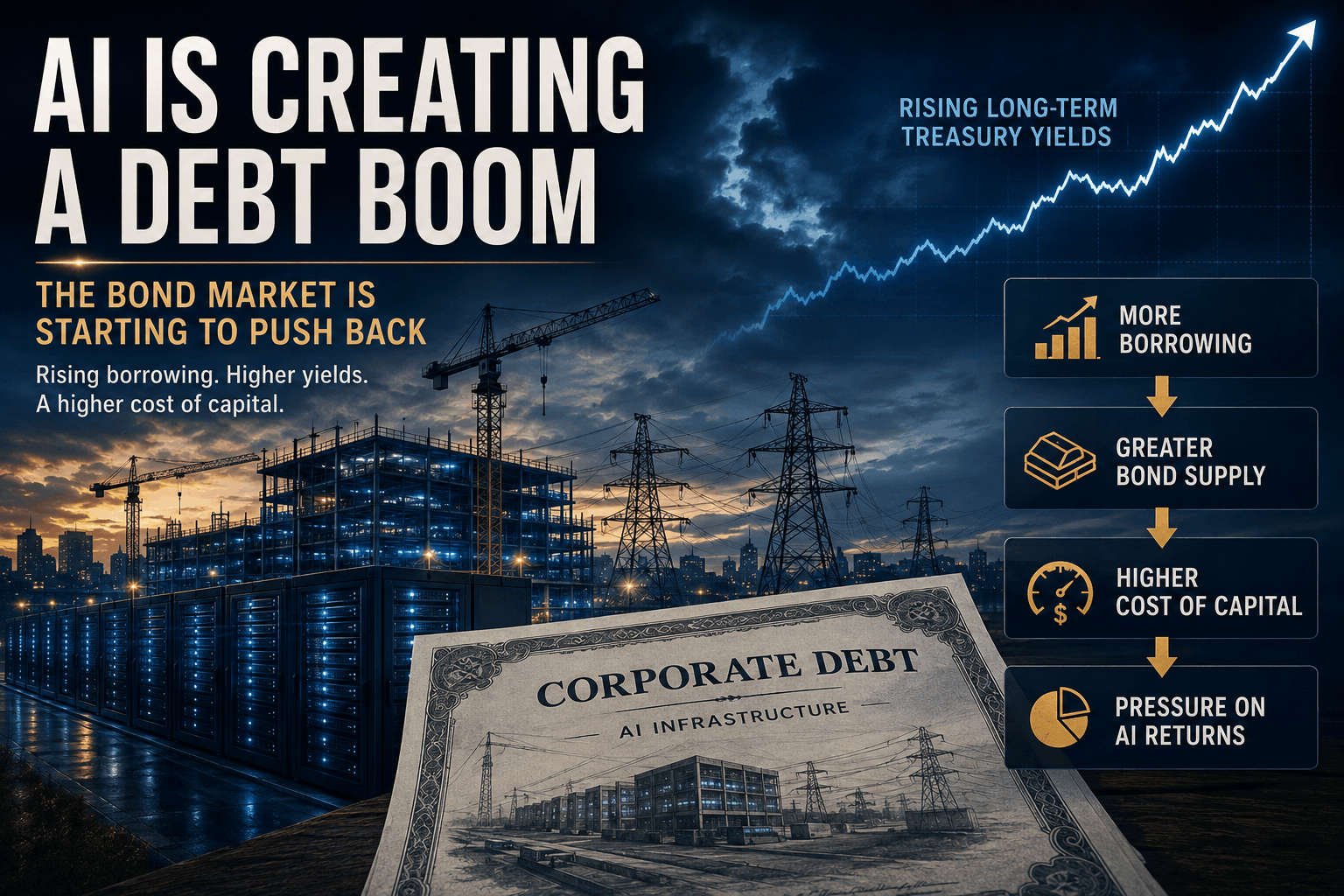
AI Is Creating a Debt Boom. The Bond Market Is Starting to Push Back.
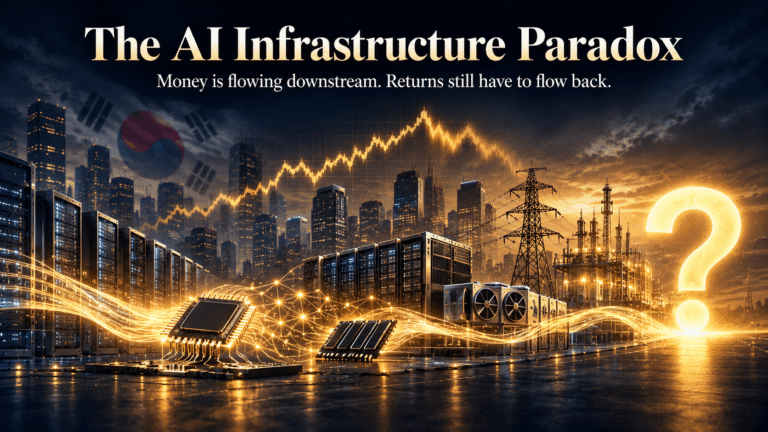
Hyperscalers and AI infrastructure companies are borrowing at unprecedented scale. As bond supply rises and long-term Treasury yields remain elevated, the cost of financing the AI boom is becoming an increasingly important risk for investors.
The artificial intelligence boom is no longer just a story about computing power, chips and rapidly growing demand. It is increasingly becoming a story about capital—and how much that capital costs.
Microsoft, Amazon, Alphabet, Meta, Oracle and other companies are committing enormous sums to build the data centers, computing infrastructure and power capacity required to support the next generation of AI. The scale of that investment is becoming difficult to fund through corporate cash flows alone, pushing companies toward debt, leases and other forms of external financing.
That creates a financial chain with implications far beyond the companies doing the borrowing:
AI capex → more borrowing → greater bond supply → higher required yields → higher cost of capital.
The rise in borrowing does not, by itself, mean that the AI boom is coming to an end. Companies may continue to invest aggressively if they believe the future revenues and profits generated by AI will justify today’s spending.
But the economics become more demanding as financing costs rise.
Long-term Treasury yields have already moved significantly higher, while investors are beginning to demand greater compensation for holding some AI-related corporate debt. At the same time, the amount of capital required to build the AI economy continues to expand.
That raises a question investors cannot afford to ignore: will the returns generated by the AI investment boom remain high enough to justify the increasingly expensive capital required to finance it?
The answer may determine which companies can sustain the next phase of the AI buildout—and which ones may find the bond market increasingly unwilling to fund it on cheap terms.
What happens when one of the world’s largest investment booms collides with a bond market that is already demanding higher yields?
The AI Spending Machine Needs More Capital
The scale of the AI buildout is easy to underestimate because much of the excitement surrounding artificial intelligence is focused on software. The underlying investment cycle, however, is increasingly physical.
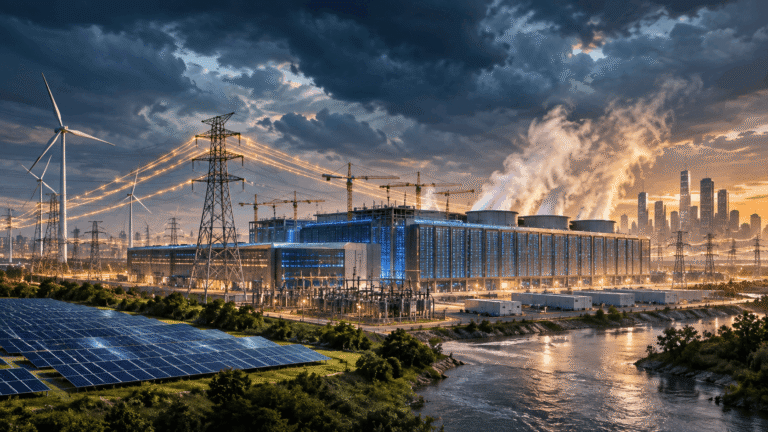
Training and running increasingly capable AI models requires enormous computing capacity, which in turn requires data centers, advanced chips, networking equipment and vast amounts of electricity. Hyperscalers are also investing in the power and physical infrastructure needed to keep those facilities operating at scale. Companies such as Microsoft, Amazon, Alphabet, Meta and Oracle are therefore committing enormous amounts of capital to expand their AI infrastructure, while Nvidia and other companies across the AI supply chain are investing to support the broader computing ecosystem.
This makes the current AI cycle fundamentally different from a conventional software investment boom.
A software company can often scale its product without making a proportional investment in physical assets. AI infrastructure does not offer the same flexibility. Every additional layer of computing capacity requires some combination of chips, data centers, networking, electricity and financing.
And the spending is happening simultaneously across the ecosystem.
Hyperscalers are building capacity to meet expected AI demand. Data-center operators are constructing the facilities those companies will use. Infrastructure providers are financing the equipment and physical assets required to make that capacity available. The result is an investment cycle in which enormous amounts of capital must be committed before the resulting infrastructure can generate its full economic return.
Corporate cash flows can fund part of this spending. But as capital expenditure continues to expand, companies increasingly have to consider external sources of financing—including bonds, loans, leases and structured financing. The source material describes this shift as an AI investment cycle that is increasingly becoming a balance-sheet story.
That distinction matters.
The question is no longer simply how much companies are willing to spend on AI. It is how they will finance that spending—and what that financing will ultimately cost.
As the AI buildout grows, the bond market is becoming an increasingly important part of the machinery supporting it.
The Debt Boom Is Getting Bigger
The scale of AI-related borrowing is beginning to match the scale of the investment boom itself.
By July 8, 2026, investment-grade bonds issued by hyperscalers, data-center developers and other AI-related companies had reached approximately $218 billion, according to the material examined for this analysis. That is almost three times the roughly $80.5 billion issued during all of 2025.
The growth is even more striking in the high-yield market.
AI-related high-yield bond issuance had already reached approximately $31.9 billion by July 2026, compared with just $2 billion during the first half of 2025. Of the 2026 total, almost $28 billion was used to finance new data centers, with the remainder going toward refinancing, general corporate purposes or companies whose businesses are closely tied to AI.
The borrowing is also spreading well beyond the traditional group of hyperscalers. Amazon, Alphabet, Meta, Oracle, Nvidia and SpaceX are among the companies participating in an increasingly broad financing ecosystem that includes data-center developers and other AI infrastructure businesses.
And the current issuance numbers may only represent the beginning of the borrowing cycle.
Goldman Sachs estimates that hyperscalers could issue approximately $250 billion of investment-grade bonds in 2026, with that figure potentially rising to around $400 billion in 2027.
The significance of these numbers goes beyond the amount of debt being raised.
When a handful of companies borrow heavily, the effect on the broader bond market may be limited. But when multiple hyperscalers, data-center operators and AI infrastructure companies simultaneously seek hundreds of billions of dollars from investors, the supply of debt itself becomes part of the investment equation.
Investors must absorb that additional supply.
And if the supply of bonds grows faster than investor demand, borrowers may have to offer higher yields—or accept wider credit spreads—to attract capital.
That creates the next link in the chain:
More AI spending → more borrowing → more bond supply → greater pressure on the price of capital.
The AI debt boom is therefore becoming more than a financing story for individual companies. It is becoming a bond-market story.
When Everyone Wants to Borrow, Someone Has to Pay More
A surge in borrowing does not automatically create a problem. The critical question is whether investor demand can keep pace with the amount of debt entering the market.
If companies issue bonds faster than investors are willing to absorb them at existing prices, borrowers generally have to offer something more attractive. That can mean higher yields or wider credit spreads.
The mechanics are relatively straightforward.
A U.S. Treasury bond provides the market’s baseline borrowing rate. A corporate bond typically has to offer an additional yield above that benchmark because investors are taking on the risk that a company could experience financial difficulties or fail to repay its debt. That additional compensation is known as the credit spread.
In simplified terms:
Corporate bond yield = Treasury yield + credit spread
Both components matter.
If a 10-year Treasury yields 4.7% and an AI-related company needs to offer a 2% credit spread, its borrowing cost would be roughly 6.7%. If the Treasury yield rises while the credit spread remains unchanged, the company’s financing cost rises automatically. If investors also become more concerned about the company’s credit risk and demand a wider spread, the cost rises further.
This is why the Federal Reserve is not the only institution that matters to the cost of financing the AI boom.
The Fed controls short-term monetary policy, but long-term Treasury yields are determined by broader market forces. Inflation expectations, government borrowing, Treasury supply, economic uncertainty and expectations for future interest rates can all push long-term yields higher—even when the Fed itself is not raising its policy rate.
That creates an important challenge for AI companies.
They are entering the bond market at a time when they are not the only borrowers demanding capital. The U.S. government is issuing large amounts of debt, while other corporations are also competing for investors’ money. At the same time, investors can choose to hold Treasuries and earn relatively high yields without taking corporate credit risk.
The result is a competition for capital.
As AI-related borrowing grows, companies may have to offer investors increasingly attractive terms to secure financing.
And that is where the AI spending boom begins to intersect with its cost of capital.
The Bond Market Is Showing Early Signs of Resistance
The clearest indication that AI borrowing is beginning to test investor appetite is not simply the amount of debt being issued. It is what happens to those bonds after they reach the market.
There are already signs that investors are becoming more selective about the price they are willing to pay for AI-related credit risk.
SpaceX provides one example. Its new 30-year bonds were initially priced at a spread of roughly 175 basis points over U.S. Treasurys. After issuance, however, the bonds traded at a spread of more than 200 basis points. In practical terms, investors were subsequently demanding a higher yield relative to Treasurys to hold the debt.
Meta’s long-dated debt has shown a similar direction of travel. The spread on its 2056 bonds reached its widest level since issuance, indicating that investors were demanding greater compensation for holding the company’s long-term debt.
The pressure becomes more visible further down the credit spectrum.
CoreWeave’s 9.625% six-year bonds, for example, fell to around 96.50 cents on the dollar, pushing their effective yield above 10%. The move is significant because bond prices and yields move in opposite directions: when investors sell a bond and its price falls, the yield available to a new buyer rises.
These examples should not be interpreted as evidence that investors have suddenly lost faith in artificial intelligence. The more important message is about price.
Investors may still be willing to finance the AI buildout—but increasingly, they may want to be compensated more generously for doing so.
That distinction matters because the cost of debt ultimately feeds back into the economics of the projects that debt finances.
For the strongest borrowers, a modest increase in spreads may be manageable. For companies operating with thinner margins, heavier leverage or more distant cash flows, however, a sustained increase in borrowing costs can materially change the economics of expansion.
The emerging signal from the bond market is therefore not:
“We don’t want to finance AI.”
It is closer to:
“If you want us to finance this expansion, we want to be paid more for the risk.”
That may prove to be one of the most important developments of the AI investment cycle.
Because once the price of capital starts rising, the question changes from how much AI infrastructure companies can build to how much they can build while still generating returns that justify the cost of financing it.
The Treasury Market Is Making AI Financing More Expensive
The pressure on AI financing is not coming only from the companies issuing debt. It is also coming from the market that sets the baseline cost against which much of that corporate debt is priced.
U.S. Treasury yields have risen to levels that matter for any company planning to borrow for the long term. The 10-year Treasury yield is around 4.7%, while the 30-year yield is around 5.26%. The U.S. government’s recent 30-year bond sale also came at its highest borrowing cost since 2001.
That matters because corporate borrowing costs are built on top of Treasury yields.
The relationship can be expressed simply:
Treasury yield ↑ → corporate borrowing benchmark ↑ → corporate bond yield ↑ → AI financing cost ↑
If an AI company must pay a spread over Treasurys, a higher Treasury yield raises its financing cost even before investors demand additional compensation for taking on corporate credit risk.
And the pressure does not necessarily require the Federal Reserve to raise its policy rate.
Long-term Treasury yields can move higher because investors are concerned about inflation, government borrowing, the supply of Treasury securities, economic uncertainty or the future path of interest rates.
For the AI industry, the distinction is particularly important because many of its investments have long time horizons. A data center, power project or large computing buildout may require enormous amounts of capital today while generating its economic returns over many years.
As the cost of long-term financing rises, the hurdle that those investments must clear also rises.
This is the essence of cost of capital.
An AI project does not simply need to generate revenue. It needs to generate enough economic returns to compensate the investors providing the capital required to build it. If the cost of that capital rises, projects that once appeared financially attractive can become less compelling at the margin.
That does not mean higher Treasury yields will stop the AI investment cycle.
It means the economics become less forgiving.
The AI boom therefore faces a second test alongside technological demand: can the returns from the enormous infrastructure being built remain high enough to justify a world in which the cost of financing that infrastructure is rising?
That question moves the debate beyond how much companies are spending on AI—and toward whether they are earning enough from that spending to make the debt behind it worthwhile.
The Real Question: Can AI Returns Outrun Its Cost of Capital?
The most important question created by the AI debt boom is not whether companies can raise enough money to keep building. So far, the capital markets have demonstrated that they can provide enormous amounts of financing.
The more important question is whether the economic returns from that investment will be high enough to justify its rising cost.
AI companies are committing extraordinary amounts of capital to data centers, chips, networking and power infrastructure. But capital expenditure does not automatically create value. The infrastructure must eventually generate revenue, cash flow and returns on invested capital that exceed the cost of financing it.
That distinction becomes particularly important as borrowing costs rise.
Consider two companies pursuing the same AI opportunity.
The first has a strong balance sheet, substantial existing cash flows and significant AI-related revenue. It can finance a meaningful portion of its expansion internally and has the financial flexibility to absorb higher interest costs.
The second relies more heavily on debt to fund a large infrastructure buildout. Its expected cash flows are further into the future, interest expenses are rising and continued access to capital markets is important to maintaining its investment plans.
Both companies may believe equally strongly in the future of AI.
But they do not face the same financial risk.
If the cost of capital remains low, the difference may be relatively easy to overlook. When financing becomes more expensive, however, the distinction becomes much more important. A project that looked attractive when capital was cheap can become less compelling when the required return rises.
This is why the AI investment cycle increasingly needs to be evaluated through the relationship between capex and cash-flow generation.
If AI-related spending produces rapidly growing revenues and eventually substantial free cash flow, higher financing costs may remain manageable. But if spending continues accelerating while the resulting revenues and cash flows take much longer to materialize, the financial burden of the investment cycle can become more difficult to sustain.
The source material points toward precisely this shift in investor thinking: the market is increasingly asking how much AI infrastructure will cost, how it is being financed, when those investments will generate cash and whether their returns will exceed the cost of capital.
That does not make rising interest rates an automatic threat to AI.
It makes them a filter.
Higher financing costs could increasingly separate companies that can fund enormous investment programs while generating strong returns from those that require continuously increasing amounts of external capital and have yet to demonstrate attractive economics.
In that sense, higher interest rates may not kill the AI boom.
They may change which companies can afford to participate in it.
The next phase of the AI cycle could therefore be less about how much capital companies can raise—and more about whether they can turn that capital into returns high enough to justify it.
The Long-Duration Problem
There is another risk hiding inside the AI-related debt boom: duration.
Some of the bonds being issued by major technology companies extend decades into the future. Alphabet has issued bonds maturing in 2075, while Amazon and Meta have issued bonds maturing in 2065. Some of these very long-dated bonds can offer yields in the range of 6.5% to 7%, which may appear attractive compared with traditional fixed-income investments.
But a high yield does not eliminate interest-rate risk.
The longer a bond’s maturity, the more sensitive its price generally is to changes in market interest rates. If Treasury yields rise, the prices of existing long-duration bonds can fall significantly because newly issued bonds begin offering investors higher yields.
That creates an important distinction:
Credit risk is not the same as interest-rate risk.
An investor can have considerable confidence that a financially strong company will eventually repay its debt and still lose money on the market value of that bond before maturity if interest rates move sharply higher.
This matters particularly in an environment where long-term Treasury yields are already elevated and remain vulnerable to inflation expectations, government borrowing and other forces affecting the long end of the bond market.
For an investor holding a bond until maturity, interim price movements may matter less if the issuer remains capable of meeting its obligations. But for investors who may need to sell before maturity—or who are managing portfolios based on current market values—the sensitivity of these long-dated securities to interest rates can be substantial.
The apparent attraction of a 6.5% or 7% yield therefore needs to be considered alongside the duration being assumed to earn it.
For investors evaluating the debt financing the AI boom, the question is consequently not only who is borrowing and whether they can repay.
It is also how long investors are being asked to lock in their capital—and how much interest-rate risk they are accepting in return.
The Interesting Alternative: Financing the Infrastructure Instead
If the bond market is becoming more demanding toward the companies driving the AI boom, investors may have another way to participate in the expansion: finance the infrastructure rather than the hyperscaler itself.
The distinction is subtle but important.
Instead of buying a long-dated bond issued directly by Microsoft, Alphabet or Meta, investors can potentially provide financing to the companies and structures building the data centers those hyperscalers need. These financings can involve data-center developers, joint ventures, real-estate companies and infrastructure investors. The underlying tenant, in some cases, can be a highly rated technology company with a long-term requirement for computing capacity.
The attraction is that the investor is gaining exposure to a physical asset that sits underneath the AI investment cycle.
Once a data center has been constructed and leased, the project can generate relatively predictable cash flows through lease payments from its tenant. That can create a different risk profile from lending directly to a technology company through an extremely long-dated corporate bond.
There may also be a yield advantage.
Morgan Stanley estimates that some investment-grade data-center bonds offer approximately 0.5 to 2 percentage points of additional yield compared with bonds issued by the underlying hyperscaler tenant. The bonds can also have potentially shorter maturities, reducing some of the interest-rate sensitivity associated with debt extending several decades into the future.
That creates an intriguing question for investors:
Could the bond market provide a way to capture the growth of AI infrastructure without taking the same degree of long-duration corporate risk associated with some hyperscaler bonds?
The answer is not necessarily straightforward. The additional yield exists precisely because investors are taking additional risks. A data center still has to be constructed, financed and powered, and its economics ultimately depend on demand for the facility and the quality and durability of its tenants.
But the distinction is important.
The AI investment opportunity does not necessarily have to be expressed as a bet on which technology company will dominate the next generation of AI.
It can also be expressed as a bet on something more tangible:
Will the infrastructure required to support the AI economy continue to be built, leased and used?
For fixed-income investors, that may represent a fundamentally different way to participate in the AI buildout—one based less on the distant financial prospects of an AI company and more on the financing of the physical assets required to make the AI economy possible.
But Infrastructure Debt Isn’t Risk-Free
The potential advantages of data-center financing should not be confused with an absence of risk. The additional yield exists because investors are accepting risks that are different from those associated with the debt of a major hyperscaler.
The first is construction risk. A data center must be completed on time and within budget before it can begin generating the expected cash flows. Delays or cost overruns can weaken the economics of the project.
Then there is power availability. Data centers require enormous amounts of electricity, and securing sufficient power can become a constraint on whether projects can be completed and operated as planned.
Political and community opposition can introduce another layer of uncertainty, particularly as large data-center developments compete for land, electricity and other local resources.
There is also tenant risk. A facility may be built around the needs of a major technology company, but the tenant could eventually decide not to renew its lease or alter its infrastructure requirements. And ultimately, there is AI demand risk: if demand for AI computing develops more slowly than expected, demand for additional data-center capacity could weaken.
The attraction of infrastructure debt, therefore, is not that it eliminates uncertainty.
It is that some of the risks may be more identifiable and measurable.
Construction progress, project costs, power availability, lease terms and tenant commitments can provide investors with specific factors to evaluate. By contrast, the long-term economics of an AI company can depend on technological developments, competitive dynamics, future demand and the ability to generate cash flows many years from now.
That distinction does not make data-center bonds risk-free.
But it does illustrate a broader point emerging from the AI financing cycle: investors may increasingly look for ways to separate the relatively tangible infrastructure required by AI from the much broader uncertainty surrounding the future economics of AI itself.
What Investors Should Watch
If the AI debt boom continues, investors will need to look beyond equity valuations and headline AI spending. The more important signals may increasingly come from the bond market and from the ability of companies to generate returns from the capital they are deploying.
First, watch the 10-year Treasury yield. The 4.3%–4.5% area identified in the source material is particularly important because the relationship between bond yields and equities has historically become more challenging when the 10-year yield moves sustainably above that range.
Second, watch the 30-year Treasury yield. It provides an important signal for the cost of long-term capital and is particularly relevant to investors holding long-duration corporate bonds and to projects whose economic returns will take many years to materialize.
Third, watch hyperscaler credit spreads. If spreads narrow, investors are demanding relatively less compensation for taking corporate credit risk. If they remain stable, financing conditions may be absorbing the increase in borrowing reasonably well. But sustained widening would suggest that investors are becoming more cautious about the amount of risk they are willing to take.
Fourth, watch the pace of AI-related debt issuance. Continued acceleration would indicate that the industry’s capital requirements are still expanding. The more important question, however, is whether investor demand grows alongside that supply.
Fifth, watch what happens to bonds after they are issued. Bonds trading above their issue price suggest strong demand, while bonds falling below their original price can indicate that investors subsequently require higher yields. The performance of newly issued AI-related debt may therefore provide an early signal of changing risk appetite.
Finally, watch AI capex against revenue and cash-flow growth. This may be the most important indicator of all.
If AI capex rises while AI-related revenue and cash flow grow faster, higher financing costs may remain manageable.
But if AI capex continues accelerating while cash-flow generation disappoints, the financing problem becomes much more serious.
That is ultimately the test investors should watch: not simply how much capital the AI economy can raise, but whether it can turn that capital into returns high enough to justify its cost.
The AI Boom Isn’t Ending. The Rules Are Changing.
The AI boom is not necessarily ending. But the financial conditions supporting its next phase are changing.
The first phase of the AI investment cycle was dominated by demand and technological potential. Companies raced to build computing capacity because they believed AI would create enormous new markets and reshape existing ones.
The next phase is increasingly about capital, financing and returns.
The chain is becoming clearer:
AI demand → massive capex → more borrowing → greater bond supply → higher required yields → higher cost of capital → greater pressure on AI investment returns → more selective capital allocation.
None of this means that companies will stop building AI infrastructure. It means the financial market may become less willing to fund every project, at any price.
As borrowing costs rise and investors demand greater compensation for credit and duration risk, companies with strong cash flows and balance sheets may have more flexibility to continue investing. Companies that depend heavily on external financing, meanwhile, may face greater pressure to demonstrate that their investments can ultimately generate attractive returns.
That could make the next stage of the AI boom more selective.
Investors may increasingly have to look beyond how much companies are spending and ask what that spending is producing: how quickly AI investments are generating revenue, when they begin producing meaningful cash flow, and whether those returns exceed the cost of the capital used to build the infrastructure.
The AI investment story is therefore entering a more demanding phase.
The next test for AI may not be whether companies can spend enough to build the future. It may be whether the future they are building can generate returns high enough to pay for it.